
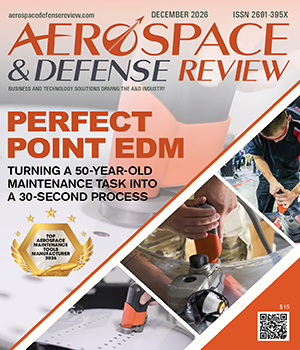
On an advanced aircraft, a repair can hinge on something surprisingly small, such as a fastener holding an airframe panel in place. During maintenance checks on aircraft such as the Boeing 737 and 787, technicians must remove panels to inspect, repair or upgrade underlying structures and systems. Despite major advances in aerospace technology, the methods used to remove the fasteners securing these panels have changed little over decades. Conventional drilling requires technicians to visually align a drill bit with each fastener and apply considerable force to remove it. Harder alloys such as steel and titanium make the process more demanding. A titanium Hi-Lok, for instance, can take five to seven minutes to remove. A misaligned drill can damage the surrounding aircraft structure, potentially requiring engineering intervention, replacement parts and rework that extend downtime. The process also scatters chips and shavings across the work area. Perfect Point EDM is modernizing this overlooked part of aerospace maintenance with E-Drill, an advanced solution that uses electrical discharge machining (EDM) to erode fastener material through a controlled, semi-automated process. Across applications, the technology is five to 10 times faster than conventional methods and reduces the risk of damage. E-Drill can remove a titanium Hi-Lok fastener in about 30 seconds—a task that takes more than five minutes using conventional methods. “We’re faster, cleaner and produce less damage to the airplane parts,” says Jim Becker, president and CEO. “We’re better for the technician, too.”
C4ISR
As global tensions rise and defense budgets hit record highs, militaries are shifting focus from firepower to foresight. As Gen. Watson of the U.S. Marines warned recently, defenders must be “relevant when the conflict arises,” or it will be too late. Achieving that level of combat readiness requires training technology that can accurately replicate enemy tactics to keep trainees on their toes. Here, precision radar-simulating antennas— like those engineered by UBC Inc—become mission-critical. Founded in 1980 by Pat and Rebecca Crane, this Florida-based, Hispanic-woman-owned company has become an indispensable supplier for the U.S. military, preparing warfighters to detect, respond to and outmaneuver today’s increasingly sophisticated threats. UBC’s signature innovation is its Cassegrain twist reflector antenna, a highly agile, lightweight system that allows for wide-angle scanning at extremely high speeds. “Our solution allows us to provide a scanning antenna without some of the cumbersome and expensive electromagnetic pieces like a rotary joint that would go along with a standard Cassegrain antenna,” says Charles Sleeper, president and CEO. In fact, very few companies around the world have mastered the technology behind UBC’s Cassegrain twist reflector antenna. The system features a Cassegrain reflector at the antenna’s front, which reflects the transmitted electromagnetic waveform onto a specially designed twist plate. This plate induces a phase shift that aligns, or co-polarizes, the signal with the main reflector, enabling efficient transmission into free space. Its innovative design achieves beam steering solely by adjusting the lightweight twist plate. The plate’s low inertia helps the system scan rapidly and with high positional accuracy without relying on heavier, slower mechanical components. UBC’s antennas can now deliver fast, precise performance that is ideal for simulating complex radar threats in dynamic environments.

Aviation

The Last Word in Aviation Safety Expertise he National Transportation Safety Board (NTSB) is widely considered the gold standard for investigating major aviation accidents and improving public safety. As a federal agency, the NTSB plays a vital role in handling large scale incidents and producing findings that inform national policy and regulation across air, rail, and marine transportation. However, its jurisdiction is not all-encompassing, and its investigations often take weeks or even months to mobilize—especially in cases involving urgent or complex issues. Not every organization can afford to wait for lengthy, government led investigations. This is where DVI Aviation steps in. DVI Aviation has become a trusted partner to aerospace manufacturers, airlines, defense contractors, MROs (Maintenance, Repair, and Overhaul providers), and operators who require timely, in-depth analyses of accidents, component failures, and unexplained anomalies. Often regarded as the private-sector counterpart to the NTSB, the company delivers rapid forensic investigations and expert analysis precisely when they are needed most. Its services not only help resolve safety issues but also inform legal strategies and prevent future failures. A Comprehensive and Confidential Approach to Forensic Investigations “Our independent and unbiased investigations are thorough, science-driven, and tailored to each client’s distinct needs— whether resolving a safety issue, informing legal strategy, or preventing future failures,” says Dr. Steven J. Meyers, President and Chief Scientist at DVI Aviation. Unlike the NTSB—whose findings are publicly disclosed and can take months to finalize—DVI Aviation offers a faster, more flexible alternative. Its team mobilizes senior experts within hours—not weeks—to investigate aerospace incidents across a broad spectrum, from aircraft and UAS/ drone failures to spacecraft mishaps and ground-support equipment breakdowns. The company provides end-to-end failure analysis, including on-site field investigations, wreckage and flight path reconstruction, metallurgical and forensic laboratory services, aircraft systems analysis, structural assessments, and expert testimony.
Space Tech

Artificial Intelligence and Manufacturing Operations, What Might The Future Look Like?
Dr. Paul Guerrier, Manufacturing Engineering Manager, Moog Inc.[NYSE: MOG.A]
A&D Suppliers & Distributors

Driving the Future of Manufacturing With AI and Digital Transformation
Andy Mears, Manufacturing Engineering, Sr. Manager - Operations Transformation & Intelligent Factory, Lockheed Martin
Aerospace Coating

AI's Pervasive Impact in Aerospace and Defense Beyond Cybersecurity
Milad Shaheen, Vice President of Engineering, CIRCOR Aerospace & Defense

IN MY OPINION
A&D Staffing
The Silver Tsunami and Its Impact on Manufacturing
Lee Housley, MSOP, SHRM-SCP, Leadership and Development Manager, Hanwha Aerospace USA

LAST WORD
MRO
Keeping Aircraft Reliability Competitive Through Its Life Cycle
Ross Peterson, Director of Engineering and Reliability, Piedmont Airlines
IN FOCUS

Revolutionizing Aerospace Maintenance: Tools for Precision and Efficiency
Aerospace maintenance tools manufacturing supports aircraft safety, improves maintenance efficiency and helps extend the service life of aircraft components and equipment.

Precision Machining in Aerospace: Delivering Quality and Innovation
Precision machining services support aerospace and defense manufacturing through accurate components, advanced CNC technologies, material expertise and consistent quality control processes.
EDITORIAL
Innovation, Leadership and the Future of Aerospace
Perfect Point EDM is leading this technological shift. Recognized as the Top Aerospace Maintenance Tools Manufacturer 2026, under President and CEO Jim Becker, the company uses its flagship E-Drill electrical discharge machining to remove titanium Hi-Lok fasteners in 30 seconds. Compared to the conventional five-minute process, it also reduces error rates from 20 percent to under one percent while protecting airframe structures. Supported by its S-Blaster technology for coating removal and rapid prototyping that takes as little as two weeks, Perfect Point EDM sets a new standard for technician safety and maintenance efficiency across commercial and military fleets.
Industry growth is driven by leaders who promote smart manufacturing and build resilient organizations. In aerospace, modern operations depend on technology that closes the gap between shop-floor maintenance and large-scale production, helping ensure smooth operations, reduce downtime and manage equipment throughout its lifecycle.
Industry leaders provide valuable insights into this changing shift. Milad Shaheen, VP of Engineering at CIRCOR Aerospace & Defense, highlights the vast potential of AI in product innovation and automated quality checks, underscoring that long-term value will be measured by ROI, data integrity and computing advancements. Fern Santos, Director of HR Operations at Pacific Aviation, stresses that cross-generational mentorship and balance create formidable, adaptable teams capable of driving organizational trust and innovation. According to Andy Mears, Manufacturing Engineering, Sr. Manager - Operations Transformation & Intelligent Factory at Lockheed Martin, combining IIoT infrastructure, predictive analytics and retrievalaugmented generation AI drives intelligent decision-making across production sites.
The future of aerospace depends on bringing together advanced tools, smart technology and strong leadership. Explore this edition's featured articles to learn how industry leaders are driving innovation and shaping the future of aerospace.
