

 On an advanced aircraft, a repair can hinge on something surprisingly small, such as a fastener holding an airframe panel in place.
During maintenance checks on aircraft such as the Boeing 737 and 787, technicians must remove panels to inspect, repair or upgrade underlying structures and systems. Despite major advances in aerospace technology, the methods used to remove the fasteners securing these panels have changed little over decades.
Conventional drilling requires technicians to visually align a drill bit with each fastener and apply considerable force to remove it. Harder alloys such as steel and titanium make the process more demanding. A titanium Hi-Lok, for instance, can take five to seven minutes to remove. A misaligned drill can damage the surrounding aircraft structure, potentially requiring engineering intervention, replacement parts and rework that extend downtime. The process also scatters chips and shavings across the work area.
Perfect Point EDM is modernizing this overlooked part of aerospace maintenance with E-Drill, an advanced solution that uses electrical discharge machining (EDM) to erode fastener material through a controlled, semi-automated process. Across applications, the technology is five to 10 times faster than conventional methods and reduces the risk of damage. E-Drill can remove a titanium Hi-Lok fastener in about 30 seconds—a task that takes more than five minutes using conventional methods.
We’re faster, cleaner and produce less damage to the airplane part. We’re better for the technician, too.
“We’re faster, cleaner and produce less damage to the airplane parts,” says Jim Becker, president and CEO. “We’re better for the technician, too.”
Becker and his colleagues bring close to Seven decades of aerospace industry experience, much of it in structural maintenance, giving them a firsthand understanding of the challenges mechanics face on the shop floor. Their experience has shaped the accessories and tools developed around E-Drill, improving precision and consistency while reducing the force required to remove fasteners. During demonstrations, mechanics often remark that they wish E-Drill had been available decades earlier.
Replacing Force with Controlled Precision
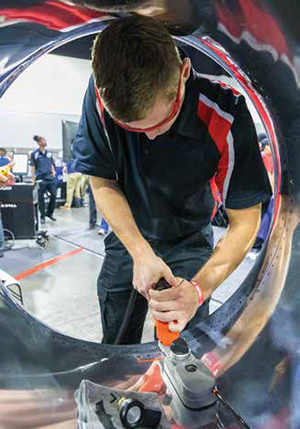
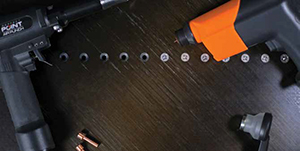
Unlike a conventional drill, which cuts into a fastener using a rotating bit, E-Drill uses a small hollow electrode to erode the fastener material through electrical discharges. The tool is programmed for the required machining depth and width, controlling the amount of removed material.
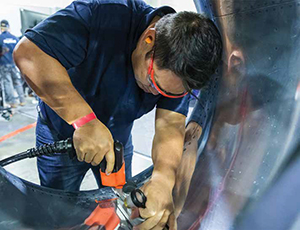 Accurate positioning is essential. Depending on the application, a technician uses a precision-fit bushing or a vacuum-aligned drill fixture to position the electrode over the fastener. An optical sight helps them center the fixture on the fastener, and specialized alignment tooling supports precise positioning.
Conventional drilling has an error rate of around 20 percent. E-Drill reduces this to less than one percent.
Once the fastener is aligned and the machining parameters are set, the technician places E-Drill in its holder and activates the cycle. The electrode erodes the fastener head to the programmed depth, then stops automatically and signals completion through an audible cue and displayed text. Automated depth control reduces the need for manual judgment during drilling, and controlled operation eliminates the need for the technician to apply the sustained force required by conventional drilling.
Extending Controlled Maintenance to Coating Removal
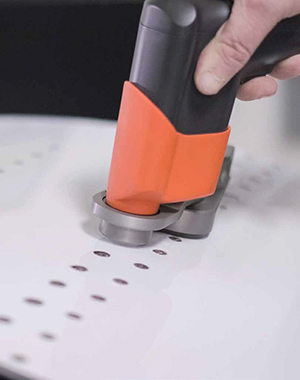
Fastener removal is one part of aircraft maintenance, while coating removal presents a different challenge. Perfect Point EDM addresses this through S-Blaster, a portable, self-recovering plastic-media blaster designed to remove paint and other coatings from aircraft components.
cOne of its primary applications is on business and private aircraft with decorative paint systems. These aircraft have access panels secured by quick-release screws. Coating can enter screw torque features, preventing a screwdriver bit from properly engaging, requiring technicians to scrape out the coating.
S-Blaster replaces this manual scraping with a controlled blasting process. The technician places a mask over the screw and directs plastic media at it to remove the coating. The handheld tool simultaneously recovers the media, keeping the surrounding area clean. The process also supports work involving the reapplication of decorative coatings.
-
We’re not just pitching a tool off the catalog. We’re sending the tool out there in the live environment.
S-Blaster replaces this manual scraping with a controlled blasting process. The technician places a mask over the screw and directs plastic media at it to remove the coating. The handheld tool simultaneously recovers the media, keeping the surrounding area clean. The process also supports work involving the reapplication of decorative coatings.
Engineering Solutions From the Shop Floor
Perfect Point EDM goes beyond supplying tools to understanding client maintenance operations and identifying opportunities to improve them. Drawing on backgrounds in aerospace maintenance, its customer-facing team evaluates tasks in the operating environment and demonstrates how E-Drill can be applied.
 “We’re not just pitching a tool off the catalog,” says Becker. “We’re sending the tool out there into the live environment.”
The assessment also establishes whether E-Drill is suitable for the task. If it is not, the team can draw on its field experience to recommend another solution.
Customer support continues beyond the initial assessment and demonstration. A seasoned technician spends two to three days at the customer’s facility, training staff to use the tool and incorporate its accessories into routine maintenance work.
These visits also allow the team to identify problems that existing tools do not adequately address. Customer feedback feeds into product development. As a quick-turn prototyping shop, Perfect Point EDM can develop solutions in as little as two weeks.
A Faster Route to Final Assembly
Perfect Point EDM’s hands-on approach proved particularly valuable for a client that faced a production bottleneck after incorrect parts were installed behind a structure. Before the product could move to final assembly, the client needed to remove 2,000 high-strength stainless-steel blind bolts under a tight deadline. Because the structure was designed to remain part of the aircraft throughout its service life and was never intended to be dismantled, the bolts had to be removed without damaging the surrounding structure.
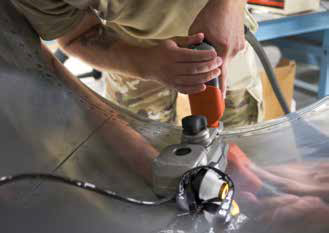 Each bolt took 30 to 40 minutes to drill out and required several drill bits. After struggling with a few bolts, the client contacted Perfect Point EDM. A capital purchase was not feasible within the available timeframe, so Perfect Point EDM arranged an on-site engagement to demonstrate E-Drill and help complete the work.
Perfect Point EDM worked alongside the client for three days, reducing the time needed to extract each bolt from 30 to 40 minutes to about 20 seconds. Following the removal of all 2,000 bolts, a detailed inspection confirmed that the airframe component had sustained no damage. The client met its production schedule at substantially lower cost and purchased an E-Drill for future use.
“We’re bringing our experience into being the sensei greybeards that people call when they get into a bind,” says Becker.
Expanding Access to Smarter Maintenance Tools
Perfect Point EDM plans to expand beyond its U.S. market to respond to growing international interest. Partnership with the U.S. military is also expected to create opportunities to expand its solutions to NATO allies.
 It is helping prepare the next generation of aerospace maintenance professionals through partnerships with organizations such as the Aerospace Maintenance Council. The council hosts an annual competition at MRO Americas, where teams from colleges, airlines and the military take part in aircraft maintenance tasks. As a sponsor, Perfect Point EDM introduces participants to E-Drill and demonstrates its use on aircraft components.
The initiative is an opportunity to share its practical experience with students and guide them as they prepare for careers in aerospace maintenance. As Perfect Point EDM expands its reach and develops solutions to field challenges, it remains focused on improving maintenance efficiency and protecting aircraft structures. These priorities underpin its recognition as Top Aerospace Maintenance Tools Manufacturer 2026.
How to Assess Aerospace Fastener Removal Tools
Removing fasteners during aircraft maintenance takes time and care. Technicians need to work quickly, but a drill that moves off-center can damage the surrounding structure. The resulting repairs or replacement parts can take far longer than the original removal. For maintenance teams, the important consideration is not simply how fast a tool removes a fastener. It is how well the tool controls alignment and cutting depth while reducing the amount of manual adjustment required.
The challenge becomes greater when technicians work with harder alloys or fasteners in confined spaces. Conventional drilling relies heavily on the technician's ability to keep the tool centered and apply the right amount of force. Even a small deviation can damage the material around the fastener. Tools that guide the cutting process and control depth can help make results more consistent. Debris is another concern. Drilling produces chips that must be removed carefully, particularly around sensitive aircraft components where foreign object debris can create additional problems.
Removal speed also affects the wider maintenance schedule. Fasteners often have to come out before technicians can reach the structures or components that need repair. If removal takes longer than planned, the work that follows may be delayed. The time needed to remove each fastener matters, but so does the preparation between removals. A tool that cuts quickly may offer little advantage if technicians spend too much time setting it up or correcting damage afterward. The overall process needs to help crews move from one fastener to the next without unnecessary delays.
Different fasteners bring different requirements. Maintenance teams may work with aluminum rivets on one job and harder-alloy fasteners on another. Sizes and access conditions can also vary. A removal system needs to accommodate these differences without making every task complicated. The way it is aligned, how cutting depth is set and whether additional fixtures are needed all affect how practical it will be on the shop floor. Consumables and routine setup also matter. A few extra minutes or additional materials may seem minor on one fastener, but the cost and time can add up when hundreds need to be removed.
“Perfect Point EDM’s E-Drill uses electrical discharge machining, alignment fixtures and programmed depth control to remove aerospace fasteners while reducing reliance on manual drilling force.”
Technicians also need to be comfortable using the equipment. A tool may perform well during a demonstration but prove difficult to use during everyday maintenance. Training should therefore reflect the fasteners and repair tasks the team actually handles. It also helps when the manufacturer can evaluate the intended application before recommending a system. Unusual fasteners or one-off repairs may require additional support or a different setup. Testing the equipment on actual maintenance work before a wider purchase can help identify these issues.
Perfect Point EDM's E-Drill uses electrical discharge machining, alignment fixtures and programmed depth control to remove aerospace fasteners while reducing reliance on manual drilling force. A precision-fit bushing or vacuum-aligned fixture centers the electrode over the fastener. Once the programmed cut is complete, the system stops automatically. This helps control the removal process and reduces the need for technicians to guide the cut manually.
The company begins by conducting a workplace audit to understand the customer's fastener removal requirements. An on-site demonstration follows, allowing maintenance teams to see how the equipment performs on their intended applications. Perfect Point EDM then provides multi-day technician training based on the purchaser's actual work scope.
For aerospace maintenance teams dealing with large numbers of fasteners, difficult alloys or work where damage to surrounding structures could delay repairs, this approach offers a way to make removal more consistent. By combining controlled cutting with application-specific demonstrations and training, Perfect Point EDM helps technicians carry out fastener removal with less dependence on manual drilling technique.
...Read more
| Share this Article: |
Company
Perfect Point EDM
Management
Jim Becker, President & CEO
Description
Perfect Point EDM develops advanced aerospace maintenance tools that make difficult tasks faster, safer and more precise. Its flagship E-Drill uses electrical discharge machining to remove aircraft fasteners with less force and risk of damage. Its S-Blaster enables controlled coating removal. Hands-on expertise, on-site support and rapid prototyping help customers solve challenging maintenance problems.
