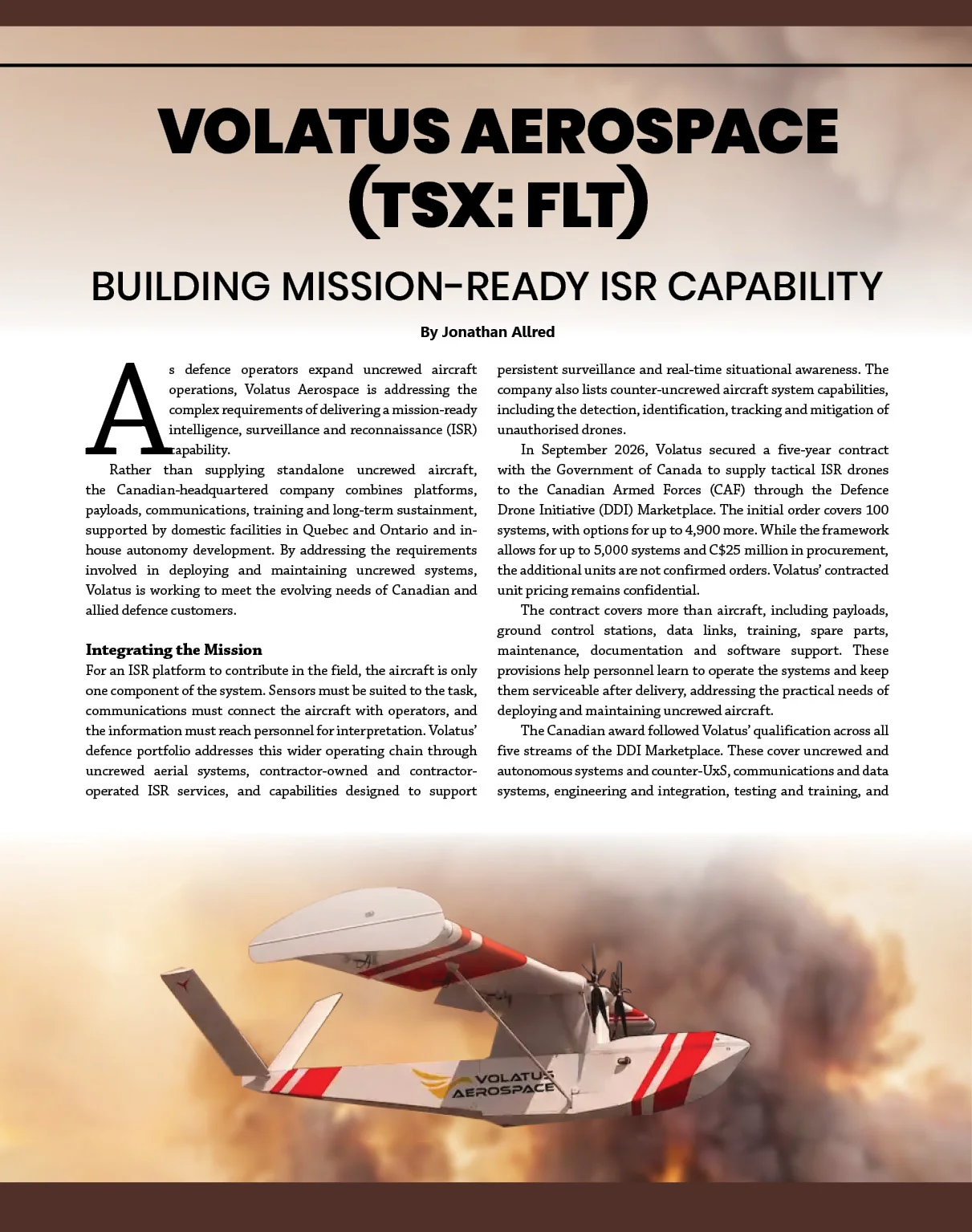
Rather than supplying standalone uncrewed aircraft, the Canadian-headquartered company combines platforms, payloads, communications, training and long-term sustainment, supported by domestic facilities in Quebec and Ontario and inhouse autonomy development. By addressing the requirements involved in deploying and maintaining uncrewed systems, Volatus is working to meet the evolving needs of Canadian and allied defence customers.
Integrating the Mission
For an ISR platform to contribute in the field, the aircraft is only one component of the system. Sensors must be suited to the task, communications must connect the aircraft with operators, and the information must reach personnel for interpretation. Volatus’ defence portfolio addresses this wider operating chain through uncrewed aerial systems, contractor-owned and contractoroperated ISR services, and capabilities designed to support persistent surveillance and real-time situational awareness. The company also lists counter-uncrewed aircraft system capabilities, including the detection, identification, tracking and mitigation of unauthorised drones.
In September 2026, Volatus secured a five-year contract with the Government of Canada to supply tactical ISR drones to the Canadian Armed Forces (CAF) through the Defence Drone Initiative (DDI) Marketplace. The initial order covers 100 systems, with options for up to 4,900 more. While the framework allows for up to 5,000 systems and C$25 million in procurement, the additional units are not confirmed orders. Volatus’ contracted unit pricing remains confidential.
The Canadian award followed Volatus’ qualification across all five streams of the DDI Marketplace. These cover uncrewed and autonomous systems and counter-UxS, communications and data systems, engineering and integration, testing and training, and innovation and experimentation. Qualification across all five streams allows Volatus to compete for a broader range of defence requirements, although it does not mean the company has delivered every capability represented by the marketplace.
Building Operational Depth
Volatus is also investing in domestic infrastructure and technology. In September 2026, the company officially opened its 53,000-square-foot facility in Mirabel, Quebec, to support manufacturing, systems integration and increased production of uncrewed platforms. Alongside its Operations Control Centre in Vaughan, Ontario, the facility strengthens Volatus’ capacity to support Canadian and allied customers.
That month, Volatus also tested its V-Cortex autonomy platform in flight, showing that it could navigate using onboard sensors without GNSS signals. This could help drones operate when satellite navigation is unavailable or disrupted. The technology will need further testing before it can be used in operations.
In October 2026, Volatus agreed to acquire AISPECO, a developer of airborne sensor systems and flightmanagement software. The acquisition could broaden Volatus’ sensing and software capabilities, complementing its work on autonomy. However, the extent to which these capabilities will be integrated into its defence systems remains to be established.
These investments address broader considerations for defence customers, who must assess more than technical specifications. Procurement teams also need to consider training, maintenance, replacement parts, software support and the resources required to sustain a fleet over time. An integrated supplier can simplify coordination across these elements when the systems and services work together as intended. Volatus’ investments in aircraft, integration, training, sustainment and domestic infrastructure reflect an approach that considers these requirements alongside equipment supply.
From Delivery to Readiness
A practical example of delivery came in October 2026, when Volatus completed delivery of the initial fleet under an ISR training systems contract with a NATO partner. The initial tranche was valued at approximately C$4.5 million, with the overall agreement worth up to C$9 million. The customer had also begun exercising the option for the second tranche, with further orders placed under the existing contract.
The programme is designed to train personnel rather than supply drones for tactical operations. It includes training aircraft, control interfaces, technical and operational documentation, instructor familiarisation, warranty coverage and lifecycle support. Together, these resources help personnel build practical skills in drone flight, navigation and basic ISR in a controlled training environment.
Training is an important part of adopting uncrewed systems. Operators need to understand controls and procedures, develop practical experience and learn how to use equipment effectively. By supplying training systems alongside documentation and instructor familiarisation, Volatus is helping the customer establish a foundation for developing these skills.
The Canadian Armed Forces contract, in contrast, supplies tactical ISR systems for land forces. Together, the two contracts show how Volatus supports both drone supply and personnel training. They also underline the difference between orders confirmed and purchases that may come later. Canada has ordered 100 systems, with the option to buy more, while the NATO-partner contract allows for additional orders. Neither agreement guarantees that its full potential value will be realised.
Together, Volatus’ recent contract awards, infrastructure expansion and technology milestones demonstrate progress across several areas of its defence business. The Canadian Armed Forces procurement, delivery of the initial NATO-partner training fleet, expansion of domestic manufacturing capacity and development of its V-Cortex autonomy platform illustrate how the company is addressing requirements beyond individual aircraft supply. For Volatus, recognition as a leading Canadian defence ISR provider reflects this combination of contract execution, operational support and investment in capabilities for Canadian and allied customers.
| Share this Article: |
Company
Volatus Aerospace (TSX: FLT)
Management
Glen Lynch, CEO
Description
Headquartered in Mirabel, Quebec, Canada, Volatus Aerospace Inc. delivers uncrewed aircraft systems, aerial intelligence services, autonomy technologies and training solutions to government, defence, public safety and commercial customers.