


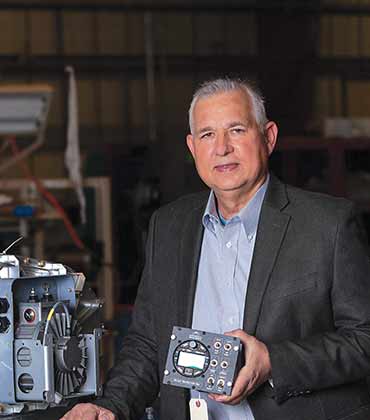
 Victor D. Trotter, President and CTO
Trotter Controls combines decades of industrial automation and process-control expertise with aviation mission-equipment engineering to address that need. It develops equipment that balances performance, weight and reliability while meeting certification requirements across different aircraft and missions.
Precise delivery of retardant depends on multiple variables, including tank level, aircraft speed, and G-forces. Trotter Controls applies control engineering to account for those variables, turning the fire gate from a mechanism that simply opens and closes into a system that manages fluid delivery throughout the drop.
The Fort Worth, Texas-based company’s roots in aerial firefighting date to 1992, when President and CTO Victor D. Trotter, Dr. Robert L. Woods and the design teams at Spectra Technologies and Air Tractor collaborated to design the original constant-flow fire gate system for the purpose-built AT802F Air Tractor firefighting aircraft. Air Tractor’s founder, Leland Snow, took an interest in Victor and mentored him.
Victor provided long-term engineering support and worldwide training for Air Tractor 1st generation firegate (FRDS GEN I) fleet, while also working on a cross-section of products, automation and robotic work-cells.
After Spectra Technologies was sold in 2004, Trotter Controls was formed with a focus on robotics, automation, oil-field equipment, circuit-board design and other industrial applications, while becoming the OEM Air Tractor supplier for the FRDS GEN I control system. In 2006, it designed the 2nd generation FRDS GEN II and remains Air Tractor’s OEM provider for the all-electric FRDS GEN III.
Our extensive IP portfolio allows us to deliver solutions that provide major advantages to the industry while differentiating us as a state-of-the-art technology provider.
When the oil-field market declined in 2015, Victor’s longstanding relationship with Air Tractor and experience with the AT802F fire-fighting systems helped accelerate the company’s transition to aviation mission equipment.
“We’ve been doing process control and automation for a long time, in addition to designing, manufacturing and supporting the control system for the Air Tractor fire-fighting fleet. We bring that broad experience base into aviation applications,” says Victor.
Today, Trotter Controls has designed, produced and supports the control system and fire-gate for over 700 aircraft worldwide.
Addressing the Control Problem behind Every Drop
During a firefighting mission, pressure at the tank outlet decreases as the retardant level falls. For a simple fire-gate system operating at a fixed angle, the retardant flow rate will be higher at the beginning of a drop and decrease toward the end, leading to uneven coverage across the burning area.
 Trotter Controls’ constant-flow technology treats retardant delivery as a control-system exercise, using real-time variables to adjust the gate position to maintain the specified ground coverage level throughout the drop. The hardware responds to changing flight conditions while retaining the fail-safe characteristics expected of aviation equipment.
An important KPI for the system is the length of ground line covered per gallon of retardant used. At coverage level two (approximately 232 gals/sec), the system can produce a ground line roughly 46 percent longer than a constant-angle system using the same payload. The efficiency of the computerized constant-flow system helps minimize the use of expensive retardant.
The same control principles extend beyond wildfire response to agricultural aviation and other fluid and material dispersal applications.
More than 25 U.S. and foreign patents underpin Trotter Controls’ work across aerial firefighting, robotics and oil-field systems. These include the all-electric fire gate architecture behind the FRDS GEN III, a redundant multi-valve configuration developed for earlier hydraulic systems, and a lightweight Coanda-effect vent that manages air intake as fluid leaves the tank. Together, these technologies address electric actuation, closed-loop control, redundancy and fluid management.
“Our extensive IP portfolio allows us to deliver solutions that provide major advantages to the industry while differentiating us as a state-of-the-art technology provider,” says Victor.
Designed as a highly configurable, open system, DataVault can read sensors, control external hardware, interact with the pilot interface and transmit information through satellite communications. It records where retardant was loaded and dropped, flight hours, the start and end points of each drop and pilot interface settings. Satellite communication and aircraft data give agencies visibility into missions and create records for subsequent analysis.
Automation Meets Human Control
Trotter Controls’ holistic systems approach is evident in the mechanical design of its systems.
For instance, its over-center electromechanical linkage uses the liquid payload’s weight to keep the gate closed. The electric motor works against the mechanism's equilibrium rather than continuously carrying the full load. A mechanical override system allows the operator to take control if the electronics develop a fault.
Microprocessor-controlled feedback and built-in-test diagnostics extend that control into the equipment itself. Electronic inputs, mechanical geometry and operator controls work together to respond to changing conditions. The result is not automation separated from the hardware but developed as part of the same mission system, allowing it to apply proven process-control principles while retaining the mechanical and human safeguards required in aviation.
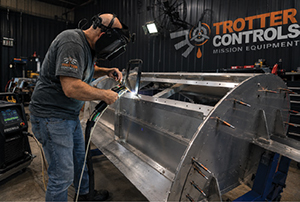
This is made possible by its broader capabilities. It architects, designs and builds systems down to the circuit-board level, including electrical and mechanical engineering, software, assembly and functional testing. Its manufacturing capabilities include circuit-board assembly, machining, aerospace fabrication, laser welding and hydraulic assembly.
Putting Data behind the Mission
Understanding what happens during firefighting is equally valuable. Trotter Controls developed DataVault after an Australian customer, in cooperation with NAFC, approached the company about adding near real-time satellite reporting capability with detailed geo-referenced fire drop system data to Australia's aircraft fleet. Following successful trials in 2016, NAFC specified the technology as a contract requirement. It has since evolved into a telemetry and data-acquisition platform for aerial firefighting operations.
-
Our team brings a holistic, cradle-to-grave systems approach to each application, and a major part of our success has been having good people and customers
Designed as a highly configurable, open system, DataVault can read sensors, control external hardware, interact with the pilot interface and transmit information through satellite communications. It records where retardant was loaded and dropped, flight hours, the start and end points of each drop and pilot interface settings. Satellite communication and aircraft data give agencies visibility into missions and create records for subsequent analysis.
Agencies can compare gallons delivered per flight hour, response times and ground-line performance. It also supports billing and proof of delivery, turning information generated during the mission into an administrative record.
Making the Fire Gate Electric
Supplemental type certificates (STCs) for the HeliMax CH47, Brainerd Helicopters UH60 and the FRDS GEN III brought Trotter Controls’ patented all-electric fire-gate architecture into the marketplace. FRDS GEN III received its STC in 2020, replacing the hydraulic hardware in earlier designs with a lightweight electric motor and gearbox.
On an Air Tractor AT802F, the system is about 300 pounds lighter, allowing roughly 33 additional gallons of retardant per mission. A patented single-shaft door arrangement significantly reduces weight, mechanical complexity and flow obstructions.
Every pound removed from mission equipment makes room for additional payload, and weight distribution influences the aircraft’s center of gravity. Eliminating the hydraulic power unit, valve manifold, accumulator and associated plumbing also reduces maintenance and infrastructure needed to support the product.
The patented all-electric technology significantly reduces the certification burden associated with a new system. For aircraft operators and manufacturers introducing new mission equipment, this means a faster path from engineering development to a certifiable system.
With over 250 turnkey systems shipped since 2020, the FRDS GEN III provides 25 percent higher flow, incorporates foam-injection control and integrates DataVault telemetry and aircraft tracking technology. The result is a fully electric, high-performance system that can empty an 800-gallon hopper in approximately 1.4 seconds or provide precision flow control for drops lasting up to 15 seconds, depending on the selected coverage level.
It is also in the final stages of certification for an all-electric fire gate system for the new 4,000-liter payload Air Tractor AT1002 with an expected 2027 product launch timeline. Trotter Controls also provides hydraulic-based solutions where an application benefits from an implementation. The objective is to engineer the architecture around the mission, certification requirements and operational environment rather than force every aircraft into a single configuration.
Building What Comes Next
Trotter Controls continues to extend control work into new aircraft programs while developing equipment around different mission requirements. Its recent work includes the development of the new Air Tractor AT1002F GEN III system. It’s all-electric Iron Arm agricultural gate actuator and control system extends this expertise across the AT502, AT602 and AT802 aircraft series.
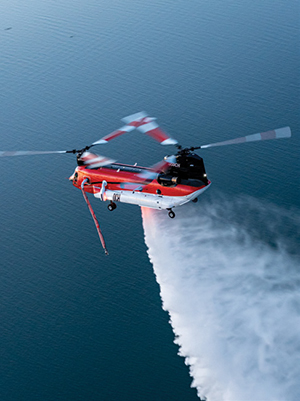 Similar all-electric technology has been deployed on various other airframes, including the current development of an all-electric fire gate system for Kepplair Evolution’s state-of-the-art ATR 72 firefighting conversion. The project involves a 7,500-liter liquid firefighting tanker, with Kepplair Evolution as the product owner, Aerotec & Concepts as the aircraft integrator, and Trotter Controls managing the gate’s mechanical and control systems as well as tank performance certification.
These new-airframe projects build on its work across previous different aircraft configurations, with successful past projects including the AT-802F, AT-1002F, UH-60, CH-47 and DC-10 platforms.
Beyond aviation, Trotter Controls has developed a state-of-the-art tubing expansion machine for catheter production, alongside other automation products.
Leveraging its core technology and IP, the company is continuously improving its offerings, focusing on lighter equipment, safety, corrosion resistance and shorter development timelines.
After decades of developing successful equipment for aviation and other demanding environments, it carefully selects the team members, customers and projects.
“Our team brings a holistic, cradle-to-grave systems approach to each application, and a major part of our success has been having good people and customers,” says Victor.
The team combines a holistic systems approach, engineering expertise, manufacturing excellence, a world-class support team and a can-do attitude to produce a turnkey, fully tested fire-gate and control system every 4 working days.
Trotter Controls’ combination of engineering depth, world-class manufacturing, support expertise, and long-term customer and vendor relationships underpins its innovative approach to aerial firefighting, earning it recognition as the Aerial Firefighting Equipment System of the Year 2026.
Identifying the Right Aerial Firefighting System
Aerial firefighting equipment has to justify more than its performance on a specification sheet. Aircraft operators are committing capital before contract revenue is certain, while certification schedules can delay when an aircraft begins bringing in revenue. Procurement turns on how quickly a system can move from integration through approval without creating avoidable aircraft modifications.
Weight matters at the same time. Equipment mass directly affects usable payload, making system architecture part of the aircraft’s economic equation rather than a secondary engineering detail.
Certification burden deserves close examination, as equipment design can either simplify or multiply the work surrounding installation. Hydraulic architectures introduce pressure-related hardware and fluid-routing requirements that must be addressed during integration. Electric actuation can remove some of that complexity, although buyers still need to examine electrical demand and aircraft-specific interfaces.
The more useful comparison is not hydraulic versus electric in isolation. It is how much installation work, certification effort and ongoing maintenance each architecture places on a particular airframe. Delays at this stage can also extend the period between equipment investment and contract availability, increasing an operator’s financial exposure.
Retardant delivery is another point where simple hardware comparisons fall short. A gate must regulate discharge as the tank head pressure changes during a drop. Ground speed and aircraft maneuvering can also affect how material reaches the target area. Constant-flow control addresses those variables by adjusting the gate rather than holding one fixed opening. Buyers should examine how accurately a system maintains the intended coverage level across the drop and how its control logic responds when flight conditions change. That performance affects how effectively a fixed onboard load is distributed along the ground line.
“Trotter Controls’ constant-flow architecture adjusts discharge based on tank level and aircraft movement, helping maintain a more consistent retardant pattern across a drop.”
Maintenance economics are closely tied to mechanical complexity. Parts count, actuator design, and component accessibility influence how much specialist knowledge is required between missions. Systems that combine hydraulic and electronic elements can create a broader maintenance burden as technicians must support multiple technologies within one installation. Fewer mechanical interfaces can reduce potential failure points, but buyers should still consider field serviceability and replacement logistics rather than treating simplicity as an automatic measure of reliability.
Mission data has also become a practical procurement consideration. Agencies may need records of where retardant was released, where aircraft were loaded, how long missions lasted and how individual assets were used. Capturing those records automatically can reduce dependence on handwritten logs while giving contracting agencies clearer information for post-mission review and billing. The important distinction is whether telemetry is integrated with the fire gate and aircraft interface or added later as a separate reporting layer.
Trotter Controls’ FRDS Gen III is built around an all-electric fire gate architecture that removes hydraulic actuation and uses a single-shaft gate design to reduce component count. Its lighter configuration can also increase available payload and influence aircraft center-of-gravity placement.
Its constant-flow architecture adjusts discharge based on tank level and aircraft movement, helping maintain a more consistent retardant pattern across a drop. DataVault adds automated mission records covering drop activity, flight use and asset location. Those capabilities address certification effort, payload economics and mission traceability, making Trotter Controls a practical option for buyers comparing integrated aerial firefighting systems.
...Read more
| Share this Article: |
Company
Trotter Controls
Management
Victor D. Trotter, President and CTO
Description
Trotter Controls designs and manufactures advanced control systems for aviation and aerial firefighting, combining decades of process engineering expertise with aircraft applications. Its solutions span all-electric fire gates, constant-flow technology, telemetry and data systems focused on safety, reliability, efficiency and faster certification.
