

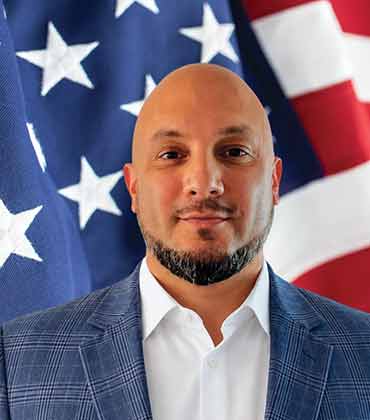
 Andrew Chavez, President
ETI Technologies and Starwin Industries address those needs through a combined manufacturing operation in Dayton, Ohio, where metallic and composite capabilities support military platforms and the people who depend on them.
Led by President Andrew Chavez, the companies bring together specialized qualifications, hands-on collaboration, and a vertically integrated approach to contract manufacturing. Customers can place responsibility for a finished product with one partner rather than spend time coordinating a chain of separate suppliers. As defense demand rises, that model keeps ETI / Starwin focused on execution.
A Manufacturing Base Built for Defense
ETI has operated in Dayton for roughly five decades and has maintained a longstanding relationship with Wright-Patterson. The company’s early work established qualifications across a broad range of U.S. fighter aircraft and rotorcraft, creating a foundation for its current role in aerospace and defense supply chains.
Today, its machining, welding, and assembly work supports the F-35 and other aircraft, while the business serves U.S. government bases around the world and supports allied customers. This work places the company within supply chains where readiness depends on parts arriving as expected and meeting exacting requirements. Its experience across aircraft platforms gives the team an understanding of the consistency customers need.
ETI / Starwin are scaling to support growing requirements across existing fleets and emerging defense applications. For Chavez, growth means building the capacity, workforce, and systems customers need as programs expand.
One Partner from Material to Finished Product
The combined operation brings together distinct strengths. ETI focuses on metallic capabilities, while Starwin holds composite qualifications. Co-locating the businesses allows them to preserve those distinctions while drawing on shared engineering, manufacturing, and operational resources.
For customers, the advantage is fewer handoffs. ETI / Starwin can manage work from raw-material procurement through outside processing, precision machining, welding, and assembly, then deliver the finished product. When a particular step requires an outside supplier, the companies manage that relationship as part of the overall order. Customers do not need to coordinate every transition themselves. This arrangement also creates a single point of accountability when requirements change or a supplier issue threatens the schedule. By managing the purchase order across multiple steps, ETI / Starwin can focus on the complete deliverable instead of treating each process as a separate transaction.
This approach reduces the administrative burden that can come with fragmented sourcing. The companies take responsibility for coordinating the process and addressing issues as they arise.
Lean Practices Create a Common Language
ETI / Starwin use lean principles as daily operating practices, not as occasional initiatives. Visual management tools make responsibilities and timelines visible across the shop, helping employees understand what needs to happen each day, week, and month.
Every business-unit employee receives at least yellowbelt training. That shared foundation gives teams a common vocabulary for identifying problems, discussing changes, and improving processes. It reduces confusion and directs attention toward practical solutions rather than competing interpretations of how work should be done.
Chavez sees this discipline as essential to making improvement routine. That shared understanding helps teams identify obstacles and respond with greater coordination. It also helps employees connect their daily tasks to production goals. When the team can see who owns a task and when it must be completed, it becomes easier to recognize delays and discuss corrective action before they affect the next stage.
Collaboration That Turns Problems into Action
The companies also build collaboration into their daily management. Leaders and cross-functional teams conduct regular Gemba walks, examining work where it happens and reviewing plans that must be executed. Exceptions are recorded as action items, creating a structured way to address obstacles and identify opportunities for improvement. The process can surface 10 to 30 discrete opportunities in a day, although not every item will prove viable or be completed immediately. The steady flow of observations matters because improvements can accumulate when teams revisit them consistently. This gives employees a practical route to raise concerns and helps leaders distinguish isolated problems from patterns that require broader attention.
“Collaboration is the most important tool that we use, and it’s free,” Chavez says.
The principle reflects a leadership approach that relies on purposeful interaction rather than hierarchy alone. It supports the companies’ ability to respond to complex customer requirements while maintaining the agility associated with a smaller business.
-
We’re partners. We’re not transactional. We connect the dots, plan, & execute despite the adversity.
The principle reflects a leadership approach that relies on purposeful interaction rather than hierarchy alone. It supports the companies’ ability to respond to complex customer requirements while maintaining the agility associated with a smaller business.
Execution Builds Customer Confidence
In aerospace and defense supply chains, trust depends on more than technical capability. Customers need candid conversations about schedules, emerging exceptions, and opportunities to improve. ETI and Starwin emphasize clear communication and follow-through, treating customers as partners rather than as parties to a transactional exchange.
Early communication helps customers understand the situation, while reliable execution gives them confidence that commitments remain a priority. This combination of transparency and accountability supports long-term relationships with aerospace primes, major suppliers, and the Department of Defense.
Quality is reinforced by experienced leadership and continued investment in expertise. The quality team includes leaders with experience at both smaller companies and major original equipment manufacturers. ETI / Starwin also consult industry specialists who can introduce new ideas and help the business interpret evolving requirements. Their goal is to meet strict performance and safety expectations while improving yield.
Chavez describes the standard in direct terms, “We’re partners. We’re not transactional. We connect the dots, plan, & execute despite the adversity.” That commitment links communication to the outcome customers value most: a finished component delivered to the required standard.
People and Technology for the Next Phase
The companies’ ability to maintain consistency also depends on workforce development. Their location in the Dayton area gives them access to a strong manufacturing and leadership community, including relationships with local technical colleges. Cross-training strengthens flexibility and helps teams share knowledge when staffing pressures arise.
Technology is another area of opportunity. Chavez sees artificial intelligence, robotics, and drones as important forces in the next phase of defense manufacturing. AI tools may help automate routine administrative tasks, improve repeatability on the shop floor, and turn concepts into viable experiments more quickly. For smaller manufacturers, developments in AI-driven drones and drone swarms may also open routes to innovation that once demanded resources beyond their reach. The aim is to use new tools where they can improve speed, consistency, or decision-making.
ETI / Starwin have doubled sales over the past couple of years, reaching levels the business had not previously seen. Looking toward 2030, Chavez anticipates further demand from expanding aircraft fleets, including the F-35, as well as drones and other fighter platforms. Meeting demand may require facility expansion, stronger infrastructure, and careful recruitment.
Growth, however, must not erase the culture that supports the work. Chavez wants the companies to become larger while preserving the small-business atmosphere in which employees can see the direct impact of their contribution to the warfighter. That means selecting people who fit the culture, developing their skills, and keeping communication close as operations expand. Named Precision Aerospace And Defense Contract Manufacturing of the Year for 2026, ETI / Starwin brings together specialized metallic and composite qualifications, end-to-end program coordination, lean discipline, and a culture of collaboration. Its promise to customers is grounded in execution: manage the details, communicate openly, and deliver dependable, reliable manufacturing support as defense needs grow.
The Case for Integrated Aerospace Manufacturing Suppliers
A machining quote can look competitive until the purchase order exposes how much work remains with the aerospace prime. Separate suppliers for finished parts, outside processing and assembly introduce handoffs that procurement teams must manage while program schedules continue to move. For defense platforms with long service lives, the price of a component tells only part of the sourcing story. The work package, and who takes responsibility for completing it, often determines the actual burden on the customer.
A contract manufacturer's scope should be established at the finished-good level rather than inferred from its equipment list. Five-axis machining may cover the most demanding geometry, yet a part can still require qualified welding or composite work before acceptance. Purchasing teams should establish whether the supplier controls material procurement and outside processing, including subcontractor performance, or expects the customer to issue separate orders. A single purchasing relationship reduces coordination only when accountability for downstream work is explicit. Otherwise, consolidation merely obscures the points where delays can develop.
Existing platform qualifications also constrain sourcing flexibility. Aircraft programs cannot always transfer work to an unfamiliar machine shop simply because capacity is available. Approved processes, documented quality systems and the ability to maintain manufacturing records affect how quickly a supplier can assume responsibility. Qualification should be examined against the specific material and production process involved, not treated as a general corporate credential. Where metallic and composite work sit under different approvals, procurement teams must verify precisely which entity is authorized to perform each assignment.
“ETI / Starwin's co-located Dayton operations combine ETI's metallic manufacturing scope with Starwin's composite qualifications, while retaining distinct approvals for the two entities.”
Production capacity presents a different risk. A supplier may have available machines but lack trained personnel who can maintain output through absences or a change in order volume. Cross-training can extend the useful capacity of an existing workforce, provided skills are documented and production assignments remain controlled. Buyers should ask how work is reassigned when staffing changes and whether engineering resources can resolve shop-floor exceptions without waiting for a separate escalation chain. An aggressive delivery promise has limited value if recovery depends on one specialist being present.
Daily production control provides evidence beyond a proposed lead time. Visible schedules should connect work orders to accountable personnel, while unresolved machining or processing exceptions reach managers early enough to affect the plan. Lean training alone does not establish that discipline. The distinction is whether recurring reviews produce specific corrective assignments and whether decisions carry through to the next production cycle. Supplier communication should extend to schedule changes before a missed shipment appears on a customer's receiving report.
ETI / Starwin manages aerospace and defense work packages from raw material purchasing through outside processing, precision machining, welding and assembly, delivering completed goods rather than leaving customers to coordinate each step. ETI / Starwin's co-located Dayton operations combine ETI's metallic manufacturing scope with Starwin's composite qualifications, while retaining distinct approvals for the two entities. Cross-trained engineering and manufacturing personnel help cover staffing disruptions. Daily cross-functional shop-floor reviews surface exceptions as assigned action items, backed by common lean training across the workforce. ETI / Starwin's approach is particularly relevant to defense procurement teams placing mixed-process orders that require one supplier to manage handoffs and maintain schedule communication.
...Read more
| Share this Article: |
Company
ETI / Starwin
Management
Andrew Chavez, President
Description
ETI / Starwin combines precision machining, composite manufacturing, welding, and assembly to support demanding aerospace and defense programs. Through integrated capabilities, lean practices, and collaborative execution, the Dayton-based company delivers dependable manufacturing solutions for military platforms and evolving defense requirements.
