
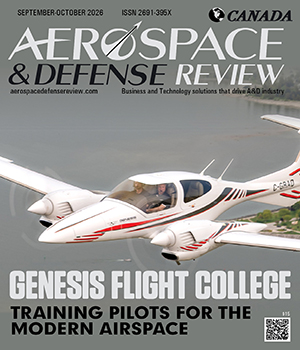
Modern airspace is no longer just about mastering flight mechanics; it’s a test of cognitive readiness. Today’s pilots must navigate increasingly complex flight systems, make real-time decisions that adhere to protocols and contend with unpredictable weather conditions, all while staying ahead of the aircraft. Yet, many commercial training programs still believe that passing exams and logging hours guarantee competence in the cockpit. Genesis Flight College sees the flaw in that thinking. Based in Collingwood, Ontario, the college is reengineering pilot training, pushing beyond the standard licensing path to shape aviators equipped to take command at 30,000 feet. “Our aim is not to mass produce pilots,” says David Gascoine, president. “The way we have built our student-centered, leadership-first model adds resilience, self-awareness and decision-making instincts that hold under pressure.” To deliver on that promise, Genesis draws on two radically different yet complementary environments; elite graduate programs and NATO-aligned air force training systems. The hybrid approach blends academic personalization with military-grade discipline. While cadets are expected to meet the same end-point standards as any Commercial Pilot License (CPL) or integrated Airline Transport Pilot License (iATPL) program, the path to get there is shaped by how each individual thinks, reacts and evolves under pressure. That level of personalization begins long before cadets step into the cockpit. Developed in collaboration with advisors from the Royal Canadian Air Force, the U.S. Air Force, and senior airline captains, Genesis’ iATPL program reflects the same attributes top airlines hire for—mindset, resilience and coachability The admissions process incorporates COMPASS aptitude testing, behavioral profiling and high-stakes group simulations that assess situat
Aviation Data Monitoring Solution in Canada 2025
Effective communication tools have always been an essential cog in the wheel of aviation operations. The narrow bandwidth devices in use today serve the intended purpose but limit satellite-based communication functionalities like tracking and messaging. Guardian Mobility (GMI) is changing this industry status quo with end-to-end connectivity, making flawless fleet tracking and new communication capability a reality. A satellite aviation specialist, GMI designs, manufactures, and develops advanced products and services to simplify tracking, reporting and communicating for fleet operators worldwide. The company provides real-time support by leveraging Iridium Certus®, a platform offering higher bandwidths at affordable prices. A one-stop shop in the aviation satellite communication space, GMI delivers a multifaceted solution that includes hardware, software, airtime and billing services. Its products are approved for government-mandated Automated Flight Following and tailor-made to transmit live video and aerial imagery over satcom in helicopters, unmanned aerial vehicles, and fixed-wing aircraft. “The average small to medium-sized aircraft with commercial satcom onboard has basic tracking capabilities. We are elevating it to a point where flight data monitoring and transmissions between the aircraft and the ground take place in real-time over an IP network,” says Stephane Momy, COO at Guardian Mobility. When its best-in-class products started making waves across the industry, a U.S. Government organization approached the GMI group to build a device that could monitor all aspects of an aircraft’s performance anywhere in the world in real time. Its team understood their requirements and designed an all-new aviation-certified product—the G6—an all-in-one satellite terminal operating over the Iridium Certus® 100 satellite constellation.

Defense Ammunition Tracking Solution

Ammunition on city streets remains a key focus in global security discussions. While larger or ample calibers often receive regulatory attention, small arms ammunition is frequently overlooked, even though it drives most street-level violence and illicit trade. The public and international organizations such as the UN and NATO continue to call for greater accountability, yet clear pathways for implementing effective traceability remain limited. Bullet ID, a Canada-based platform, is helping to bridge that gap. Its end-to-end traceability doesn’t just track where ammunition goes but documents how each round is manufactured and what materials are used to ensure data integrity across jurisdictions. Marked with a unique identifier during high-speed laser engraving at the point of production and linked to a secure digital record, each round becomes individually traceable. The system captures the full lifecycle, from raw material inputs and batch-level manufacturing to packaging and deployment. Integrated directly into the production workflow, Bullet ID delivers this level of visibility at an industrial scale, without slowing throughput, whether 500,000 or several million rounds per day. “If a cartridge is found in the field, on a base or in a civilian setting, it can be traced back to the exact case it shipped in and its distribution point,” says Cristian Talle, CEO. “This gives defense forces the ability to monitor inventories precisely, investigate diversion risks and improve accountability across the supply chain.” This is especially timely as NATO-aligned countries seek to manage joint stockpiles more effectively and prevent expired or counterfeit rounds from entering circulation. Estimates suggest that 20 percent of global ammunition circulates outside formal systems, affecting public safety and regional stability. Bullet ID addresses this vulnerability with a system built on open, internationally recognized standards for secure interoperability. Without overhauling existing infrastructure, governments can link every round to metadata like shelf life, deployment history and location. The result is an ammunition ecosystem that’s secure and data-ready. “We’re not here to regulate—we’re here to empower. BulletID helps manufacturers deliver smarter, safer, and more trusted munitions,” says John Tsihlis, commercial director. “We’re seeing a shift: defense and law enforcement authorities both want accountability for ammunition inventories, but without complexity. BulletID delivers exactly that!”
A&D Manufacturing

Building Innovative and Game-Changing Planes
Anthony Cox, Vice President - Customer Support, Bombardier [TSE: BBD.B]
MRO

Keeping Aircraft Reliability Competitive Through Its Life Cycle
Ross Peterson, Director of Engineering and Reliability, Piedmont Airlines
A&D Logistics

Insights into Streamlining Flight Operations
Carrie Haase, Chief Pilot, Aurora Flight Sciences
A&D Training & Simulation

Reimagining Ground School: From Lectures To Learning
Josh Bricker, MBA(HRMgt), MBA(EntMgt), ACC, ATPL , Manager of Training and Development (Assistant Chief Pilot, Dash 8), and Cody Moynes, HBSc, ATPL, Captain - Dash 8, Porter Airlines Inc.
Defense Solutions

Aviation Logistics & Supply Chain
John Martin, Vice President of Global Supply Chain, CMP Advanced Mechanical Solutions

IN MY OPINION
Advanced Airborne Training
Convenience - Driving Force Towards Autonomous Flight
Jeffrey Lai, M.Sc. Training Development Manager, Flair Airlines

LAST WORD
A&D Training & Simulation
Dichotomous Reflection: Technological Convergence vs. the Relentless Reality of Nature
Stéphane Rousseau, Vice President of Information Technology, Air Inuit
IN FOCUS

Soaring Towards Sustainability: Canada's Aircraft Cabin Innovations
Aircraft cabin interiors are evolving to enhance comfort, technology, and sustainability, creating a more passenger-friendly experience in air travel.

Harnessing Technology: The Evolution of Canada's Marine and Defense Industries
Driverless boats, energy-efficient technologies, and automation are key trends in the marine and defense sectors.
EDITORIAL
A Glimpse into Canada’s Aerospace and Defense Renaissance
From Arctic surveillance and AI-powered threat detection to hybrid-electric aircraft and naval modernization, Canada is stepping into a more prominent role as a center of innovation and strategic capability.
However, this evolution comes with challenges. The sector continues to face fragile supply chains, outdated infrastructure, skilled labor shortages, and variations in procurement policies across provinces and trade partners. There is also an ongoing effort to reduce reliance on foreign technologies while maintaining close partnerships with NATO, the U.S. through NORAD, and the Five Eyes alliance.
Despite these complexities, Canada’s A&D players are moving forward with purpose. Federal and provincial governments are expanding support for innovation through initiatives like the Innovation for Defence Excellence and Security (IDEaS) program. Industrial and Technological Benefits (ITB) policies are encouraging local manufacturing and technology transfer, helping to boost domestic capability and job creation.
Across the country, firms both large and small are making strides in advanced manufacturing, autonomous systems, cybersecurity, and space technologies. Strategic programs like the National Shipbuilding Strategy, the fighter jet replacement initiative, and efforts to modernize the Canadian Armed Forces underscore a long-term commitment to readiness and resilience.
Procurement frameworks are being updated. R&D ecosystems are expanding through collaborations with universities, startups, and defense technology clusters. Funding mechanisms are adapting to support long-term innovation and national security goals.
As Canada strengthens its role in the global A&D landscape, its future will be defined by innovation, collaboration, and strategic independence. This issue features the companies, programs, and insights that are shaping this transformation. We hope these perspectives help you make more informed, forward-thinking decisions in today’s complex defense environment.
