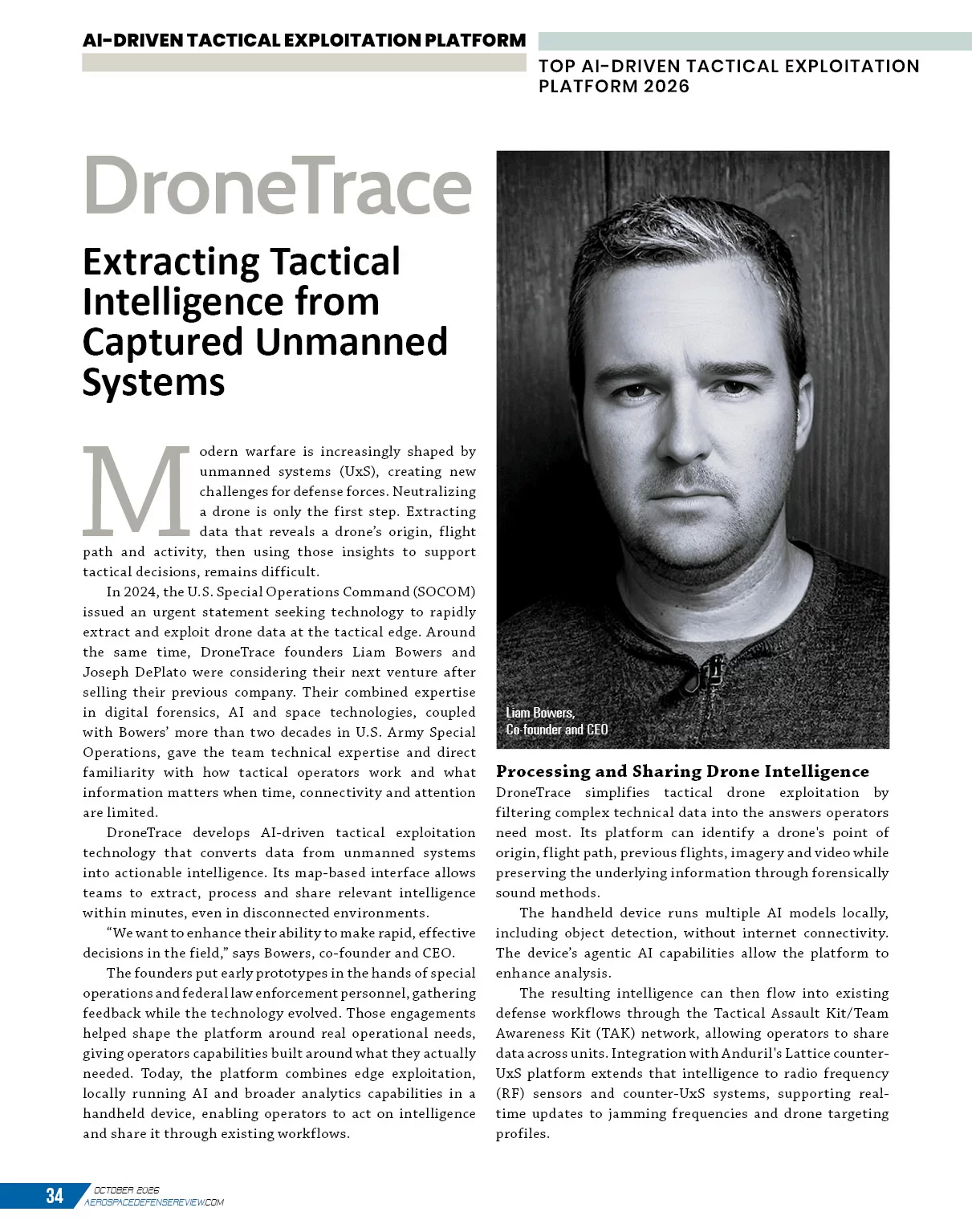


 Liam Bowers, Co-founder and CEO
In 2024, the U.S. Special Operations Command (SOCOM) issued an urgent statement seeking technology to rapidly extract and exploit drone data at the tactical edge. Around the same time, DroneTrace founders Liam Bowers and Joseph DePlato were considering their next venture after selling their previous company. Their combined expertise in digital forensics, AI and space technologies, coupled with Bowers’ more than two decades in U.S. Army Special Operations, gave the team technical expertise and direct familiarity with how tactical operators work and what information matters when time, connectivity and attention are limited.
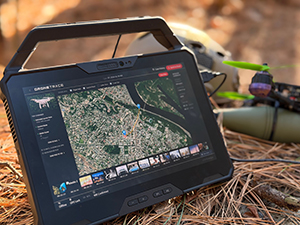
DroneTrace develops AI-driven tactical exploitation technology that converts data from unmanned systems into actionable intelligence. Its map-based interface allows teams to extract, process and share relevant intelligence within minutes, even in disconnected environments.
“We want to enhance their ability to make rapid, effective decisions in the field,” says Bowers, co-founder and CEO.
The founders put early prototypes in the hands of special operations and federal law enforcement personnel, gathering feedback while the technology evolved. Those engagements helped shape the platform around real operational needs, giving operators capabilities built around what they actually needed. Today, the platform combines edge exploitation, locally running AI and broader analytics capabilities in a handheld device, enabling operators to act on intelligence and share it through existing workflows.
 Processing and Sharing Drone Intelligence
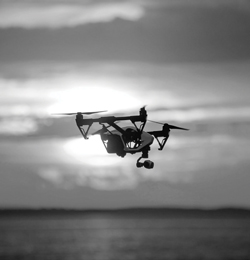
DroneTrace simplifies tactical drone exploitation by filtering complex technical data into the answers operators need most. Its platform can identify a drone's point of origin, flight path, previous flights, imagery and video while preserving the underlying information through forensically sound methods.
The handheld device runs multiple AI models locally, including object detection, without internet connectivity. The device’s agentic AI capabilities allow the platform to enhance analysis.
The resulting intelligence can then flow into existing defense workflows through the Tactical Assault Kit/Team Awareness Kit (TAK) network, allowing operators to share data across units. Integration with Anduril's Lattice counter-UxS platform extends that intelligence to radio frequency (RF) sensors and counter-UxS systems, supporting real-time updates to jamming frequencies and drone targeting profiles.
-
We want to enhance their ability to make rapid, effective decisions in the field.
Adapting Drone Intelligence to Mission Needs
DroneTrace supports the distinct operational requirements of military, special operations and federal law enforcement organizations. Federal agencies rely on its data collection to strengthen investigations and prosecutions. Military and special operations teams use the platform to accelerate targeting and tactical decisions.
Supporting this flexibility is a multidisciplinary team of software engineers, data scientists and experienced drone reverse engineers. The data science team analyzes information from different drone makes and models, while the reverse engineers specialize in commercially available and foreign nation-state drones.
Preparing for the Future of Unmanned Systems
 DroneTrace is extending its tactical exploitation focus beyond aerial drones to the broader unmanned-systems environment, including unmanned ground vehicles, maritime equipment, humanoid robots and robotic dogs.
AI is used to support rather than replace human judgment. The platform distinguishes AI-generated insights from raw exploitation data and makes the underlying information available across its edge and cloud platforms for independent validation.
Continuous operational feedback from special operations laboratories and U.S. Army Special Forces units helps validate new capabilities through training exercises and live training missions, including nighttime operations.
By combining digital forensics, AI and frontline insight, DroneTrace turns complex unmanned-system data into timely, actionable intelligence. As the battlefield expands beyond aerial drones, the company remains focused on giving operators the information they need to make faster, better-informed decisions at the tactical edge.
Evaluating AI-Driven Tactical Exploitation at the Mission Edge
Drone exploitation has moved from a specialist intelligence function toward the point of contact. Small unmanned systems now appear across military missions, yet useful data can remain trapped in devices without technical specialists or rear-echelon analysts. That delay can erase the value of information about launch locations, flight trajectory, imagery and pilot signatures. Procurement decisions must assess whether a platform can extract and organize relevant intelligence before the tactical window closes.
Speed alone is a poor buying test. A system may process technical data and still burden the operator with raw files or unfamiliar forensic steps. Teams working under heat, fatigue, threat and time pressure need a limited set of answers presented clearly enough to guide immediate judgment. Interfaces should surface origin points, flight paths, stored media and prior activity without concealing the evidence used to reach those findings.
Disconnected use deserves equal weight. Tactical units cannot assume stable internet access or reliable cloud reach-back. AI models that depend on remote processing may perform well in demonstrations but become unreliable without supported networks. Local analysis on a handheld device protects mission tempo and reduces dependence on external infrastructure. Human control also needs to remain visible. AI should shorten familiar analytical work and distinguish generated insights from source data while leaving targeting decisions with trained personnel.
“DroneTrace integrates with the Tactical Awareness Kit and Anduril’s Lattice platform, allowing exploitation data to enter existing command, targeting and intelligence workflows.”
Integration often decides whether exploitation data becomes actionable or merely archived. Intelligence from a recovered drone gains value when it can be pushed into systems used for mapping, command-and-control activity, targeting support and adjacent-unit coordination. Manual transfer creates delay and increases the chances of findings remaining isolated from the people who need them. Buyers should examine whether a platform shares data through established defense networks and preserves context during transfer while supporting immediate distribution and deeper analysis.
Procurement teams must test how a platform handles damaged devices, unfamiliar drone models and incomplete records. Recovery conditions are rarely controlled, and adversaries can modify hardware or software without notice. Broad device coverage matters only when extraction remains repeatable, evidence handling stays clear, and updates can reach fielded systems without disrupting mission procedures.
Mission differences complicate platform selection. Special operations units may prioritize rapid extraction that feeds an active targeting cycle, while federal law enforcement teams require forensic collection that can withstand evidentiary review. A platform must support both forms without forcing one group into another’s workflow. It should also adapt as unmanned threats extend beyond aerial drones into ground systems, maritime platforms, humanoid robots and other autonomous devices. Purchasing decisions made around a single device type can create another replacement cycle as the threat mix changes.
DroneTrace addresses these pressures through an AI-driven tactical exploitation platform built for recovered unmanned systems. Its handheld device processes drone data locally, presents mission-relevant findings through a map-based interface and preserves the underlying forensic record for independent review. AI supports analysis without automating sensitive decisions.
It integrates with the Tactical Awareness Kit and Anduril’s Lattice platform, allowing exploitation data to enter existing command, targeting and intelligence workflows. The design supports rapid military use alongside forensically sound law enforcement collection, giving defense buyers a practical option when disconnected access must coexist with speed, evidentiary integrity and human judgment.
...Read more
AI-Driven Tactical Exploitation Platforms Info
Q1
What Are AI-Driven Tactical Exploitation Platforms Used For?
AI-Driven Tactical Exploitation Platforms help operators extract useful intelligence from recovered unmanned systems without waiting for data to move through centralized forensic processes. They can organize information such as flight activity, imagery, video and other device data into findings that support time-sensitive operational decisions. Their value depends on how quickly relevant information can be accessed, understood and shared while preserving the underlying evidence for further review.
Q2
How Does DroneTrace Apply AI-Driven Tactical Exploitation at the Mission Edge?
DroneTrace applies AI-Driven Tactical Exploitation Platforms to captured unmanned systems through a handheld capability designed for use where the device is recovered. Its map-based interface helps operators identify information including a drone's point of origin, flight path, previous activity and stored imagery or video. The platform processes data locally and can run AI models without internet connectivity, allowing analysis to continue when network access is limited or unavailable.
Q3
Why Is Local Processing Important for Tactical Exploitation?
Many AI-Driven Tactical Exploitation Platforms are evaluated by how well they perform when cloud access or reliable communications cannot be assumed. Local processing can reduce dependence on reach-back infrastructure and allow intelligence to be examined within the operational window in which it is most useful. At the same time, AI-generated findings should remain distinguishable from the underlying source data so operators can review the evidence and retain human judgment over consequential decisions.
Q4
What Should Organizations Look for When Evaluating AI-Driven Tactical Exploitation Platforms?
Organizations assessing AI-Driven Tactical Exploitation Platforms should look beyond processing speed. Important considerations include the ability to work with unfamiliar or damaged systems, present findings without overwhelming users with technical data and preserve information through sound forensic methods. Integration also matters because intelligence loses value when it remains isolated on a single device. A platform should fit established command, intelligence and operational workflows while allowing information to move quickly to the people who need it.
Q5
How Does DroneTrace Connect Exploitation Results to Existing Workflows?
DroneTrace extends AI-Driven Tactical Exploitation Platforms beyond initial extraction by allowing resulting intelligence to move through existing operational networks. Its platform can share information through the Tactical Assault Kit/Team Awareness Kit environment, helping findings reach other units and workflows. It also integrates with Anduril's Lattice counter-UxS platform, connecting exploitation results with additional systems involved in operational awareness and counter-unmanned-system activity. When deeper examination is required, exploitation data can also move from the handheld capability into a cloud analytics environment for further forensic analysis.
Q6
How Are Tactical Exploitation Needs Changing as Unmanned Systems Evolve?
The scope of AI-Driven Tactical Exploitation Platforms is expanding as unmanned systems move beyond conventional aerial drones. Future requirements may involve ground and maritime systems as well as other robotic platforms, increasing the importance of adaptable exploitation capabilities. DroneTrace is extending its focus across this broader unmanned-systems environment while maintaining an approach in which AI assists analysis rather than replacing human judgment. That distinction becomes increasingly important as operators need faster intelligence without losing visibility into the evidence behind automated findings.
| Share this Article: |
Company
DroneTrace
Management
Liam Bowers, Co-founder and CEO
Description
DroneTrace is a defense technology company that enables frontline operators to rapidly exploit captured unmanned systems. Its AI-powered tactical platform transforms drone data into actionable intelligence at the point of capture, accelerating operational decision-making without relying on centralized forensic laboratories.