


 Creig Rice, Vice President of Corporate Development and Director of Operations
“We call ourselves the applied scientists of wildland fire,” says Creig Rice, Vice President of Corporate Development and Director of Operations.
Rice’s description captures Bode’s approach to innovation, which centers on turning emerging sensing, communications and data-processing technologies into operational systems for wildfire missions. The company identifies technologies with practical potential, determines how to integrate them into aircraft and mission systems that meet mission needs, and develops ways to deliver useful information to crews in the field. Its progression from electro-optical and infrared (EO/IR) sensing to airborne satellite connectivity and AI-assisted detection reflects a consistent focus on making emerging technology work under demanding operational conditions.
A Faster View of a Changing Fire
Wildfires can change faster than ground-based teams can observe them. Smoke, terrain and shifting weather conditions complicate detection, particularly when lightning events or emerging fires require aircraft to cover widely separated locations. Bode combines airborne sensing with the speed and altitude of its jet platforms to help crews reach developing situations, locate fire activity and put information into the hands of those directing the response.
Introduced into Bode’s wildfire operations over a decade ago, EO/IR technology gives crews another way to detect fire activity when visibility is limited. The sensors help operators identify spot fires beyond established fire lines and examine areas obscured by smoke. By transmitting the resulting imagery to incident commanders, Bode connects airborne observation with decisions about resource positioning, evacuation and response priorities.
Bode operates four Citation jets and one Pilatus PC-12 under a U.S. Forest Service Multiple Award Task Order Contract (MATOC), alongside two additional PC-12 aircraft supporting the State of Colorado. Since the previous interview, the company has doubled its Citation fleet, bringing the total number of aircraft supporting this wildfire work to seven. One Citation combines an EO/IR camera, Starlink connectivity, multiple radios and an integrated mission system, bringing sensing and communications capabilities together in a single airborne platform.
The Citation’s speed is particularly valuable during the shoulder seasons, when emerging fires can occur across widely separated locations. Rice describes the operational period as extending from January through April and again from October through December. A jet can reposition rapidly between locations, allowing Bode to bring sensing and communication capabilities to emerging incidents without waiting for an aircraft already operating nearby. Faster repositioning supports earlier observation, giving incident teams more time to assess conditions and direct resources.
Bode selects and configures its aircraft around the demands of each mission, integrating sensors, communications equipment and mission systems into a coordinated operational platform. The Citation provides speed and altitude for rapid repositioning, while the PC-12 offers a complementary platform for other operational requirements. Equipment selection follows the task rather than a single configuration applied across the fleet.
-
We call ourselves the applied scientists of wildland fire.
The integrated mission system connects the aircraft’s sensors and communications equipment, helping operators manage information and deliver it to the people who need it in real time. Multiple radios support communication across the response environment, while airborne sensors reveal fire activity that ground teams may struggle to observe. The resulting integration brings detection, communication and information delivery into one operational workflow.
Safety shapes how that workflow is developed and executed. Bode emphasizes incident reporting, root-cause analysis and the use of operational experience to improve procedures and training. The company recently adopted a FAA Corporate Safety Management System that took its already approved FAA Safety Management System Voluntary Program for 14 CFR Part 135 operators and included all flight and maintenance operations, including its repair station and flight school. Employees are encouraged to raise concerns and discuss mistakes openly, while incident reviews examine whether procedures were followed and whether additional training or changes to established practices are needed.
Bode applies this philosophy by reviewing how procedures work in practice and using lessons from routine events to prevent more serious problems. The company maintains established operating procedures and an AS9100D and AS9110C quality management system, with annual audits supporting its focus on accountability and continuous improvement. Safety and quality remain integral to mission planning, equipment integration and operational reviews.
Connectivity Turns Images Into Action
Airborne imagery matters most when it reaches decision-makers while the information remains operationally relevant. Bode uses airborne satellite connectivity to transmit high-resolution imagery and mission data while providing an additional communication option when conventional radio connections are inadequate.
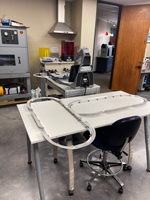 Bode adopted Starlink for airborne operations approximately two and a half to three years ago, when the technology was still relatively new to aviation. Rice says Bode was the first to install Starlink on a PC-12, an early move that preceded wider adoption of airborne satellite connectivity among wildfire operators. He also describes growing procurement interest in satellite communications from the U.S. Forest Service and Wildland Fire Service, reflecting the operational importance of maintaining connectivity in remote environments.
The system enables aircraft to transmit imagery and other mission data to personnel on the ground, including live EO/ IR feeds that help incident commanders monitor developing conditions. Connectivity can also support voice-over-IP calls, giving crews another way to relay information when radio links are unreliable. For incident commanders, the benefit is not simply access to aerial imagery but the ability to receive observations while they remain relevant to decisions on the ground.
Adding AI to the Detection Workflow
Bode is developing artificial intelligence and machine-learning capabilities to help operators analyze the growing volume of information collected during a mission. The company has partnered with an academic institution on its AI work and has also worked with NASA as it explores emerging technologies for this mission set.
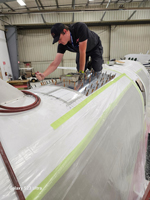 One area of development involves an AI agent designed to analyze camera imagery alongside the sensor operator. The aim is to identify potential fire starts the operator might otherwise overlook while concentrating on another part of the scene.
Lightning-event detection provides a practical example of the intended workflow. Identified lightning strikes can be loaded into the mission system as data points that direct the camera toward locations of interest. As the sensor operator monitors the feed, the developing AI capability would analyze the imagery in parallel, identifying additional points of interest that may warrant inspection.
Once an area has been scanned, the operator could review the system’s suggestions and return to locations that warrant closer examination. The operator would then determine whether a suspected fire or another meaningful event is present before the information informs an operational decision. Human verification remains essential, keeping responsibility for interpreting imagery and determining appropriate action with the operator.
Building Toward a More Connected Picture
Bode is exploring technologies that could expand the range of information available during wildfire operations. Wide-area imaging could collect extensive imagery for AI-assisted analysis, while wearable or mixed-reality displays could help air-attack personnel visualize the positions of ground forces, helicopters, air tankers and the fire line. Bode is also exploring autonomous sensing on air-attack aircraft, allowing imagery to be collected for later analysis without requiring pilots or air-attack personnel to manage every observation.
 The longer-term ambition extends beyond combining feeds from different sensors. Rice wants information to be processed and presented in ways that help operators understand the situation without having to interpret several separate systems. Observations from crewed aircraft, uncrewed aircraft systems, ground vehicles and space-based sensors could contribute to a more coherent operational picture. The challenge is to develop intuitive interfaces that identify what matters and make the resulting information immediately useful to the person directing the mission.
Wide-area imaging, mixed-reality interfaces and broader sensor fusion remain areas of exploration rather than fully deployed capabilities. Further development, integration and validation will be needed to establish their operational value. Bode’s applied-science approach centers on determining which technologies solve real mission problems, how they fit into existing aircraft and workflows, and how their outputs can be presented in a useful form.
The same integration expertise may also apply to selected government and defense missions. Although sensors, tactics and operational requirements differ, many of these environments present a similar challenge. Operators must interpret complex information from multiple sources and make decisions under time pressure. Bode’s aviation, systems-integration and operational experience provides a foundation for exploring those applications, subject to the requirements of each mission.
Bode Aviation’s defining contribution lies in connecting the stages between observation and action. Its aircraft reach developing incidents, airborne sensors detect activity that might otherwise go unseen, satellite links deliver imagery to decision-makers and AI-assisted tools under development aim to help operators identify locations that warrant closer examination. Each capability strengthens the next, turning emerging technology into practical support for wildfire operations.
Bode Aviation’s recognition as a Top Aviation Solutions 2026 honoree by Aerospace & Defense Review reflects an approach built around practical innovation. By connecting aviation expertise with sensing, communications and emerging analytical tools, the company is working to ensure that information collected in difficult operating conditions reaches the people who need it in a form they can use.
| Share this Article: |

Company
Bode Aviation
Management
Creig Rice, Vice President of Corporate Development and Director of Operations
Description
Bode Aviation integrates specialized aircraft, advanced sensing technologies and satellite communications to deliver actionable intelligence for wildfire operations. By combining aviation expertise with emerging AI and sensor-fusion capabilities, the company helps decision-makers gain clearer situational awareness and make informed operational decisions.
