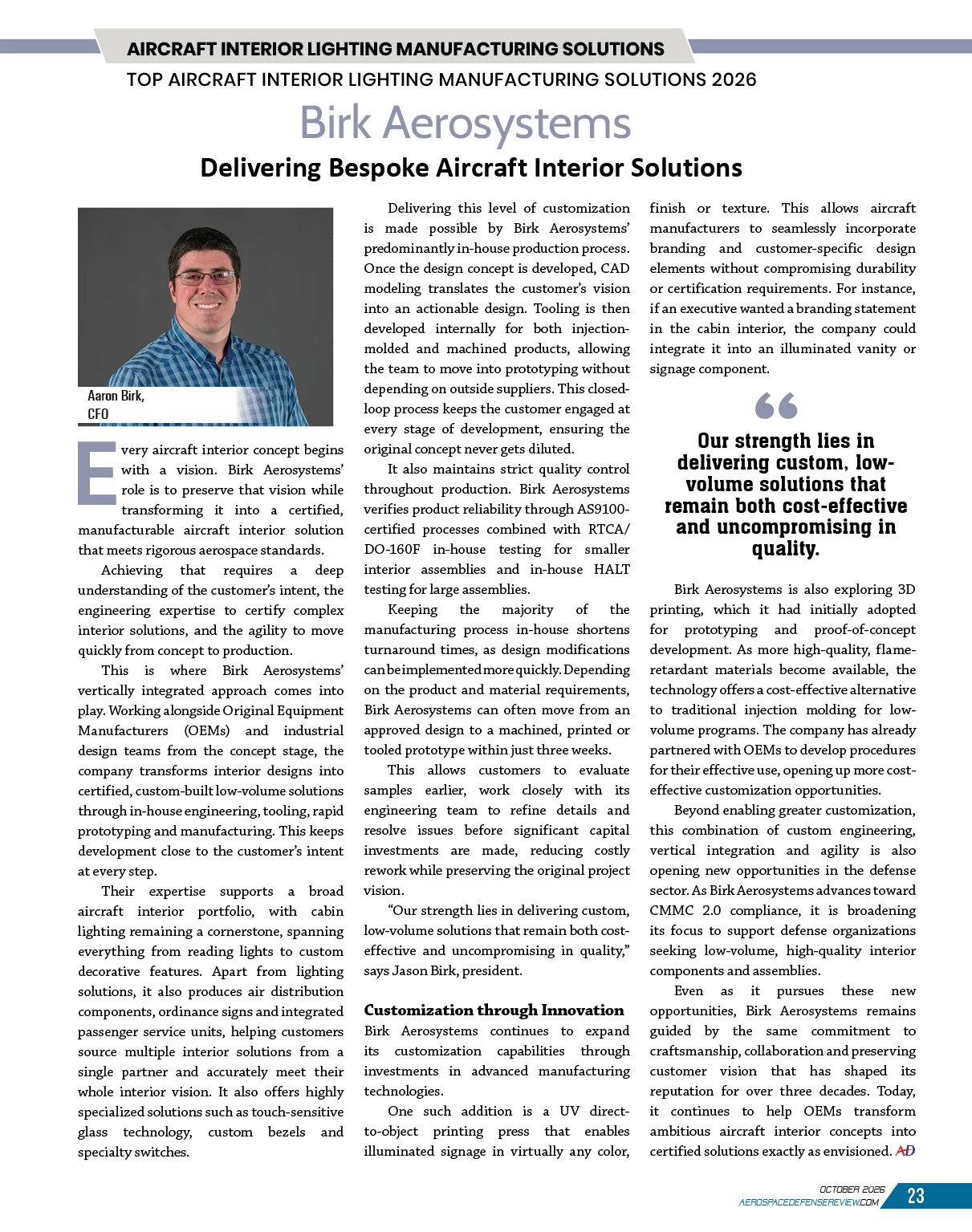
 Aaron Birk, CFO
Achieving that requires a deep understanding of the customer’s intent, the engineering expertise to certify complex interior solutions, and the agility to move quickly from concept to production.
This is where Birk Aerosystems’ vertically integrated approach comes into play. Working alongside Original Equipment Manufacturers (OEMs) and industrial design teams from the concept stage, the company transforms interior designs into certified, custom-built low-volume solutions through in-house engineering, tooling, rapid prototyping and manufacturing. This keeps development close to the customer’s intent at every step.
Their expertise supports a broad aircraft interior portfolio, with cabin lighting remaining a cornerstone, spanning everything from reading lights to custom decorative features. Apart from lighting solutions, it also produces air distribution components, ordinance signs and integrated passenger service units, helping customers source multiple interior solutions from a single partner and accurately meet their whole interior vision. It also offers highly specialized solutions such as touch-sensitive glass technology, custom bezels and specialty switches.
Delivering this level of customization is made possible by Birk Aerosystems’ predominantly in-house production process. Once the design concept is developed, CAD modeling translates the customer’s vision into an actionable design. Tooling is then developed internally for both injection-molded and machined products, allowing the team to move into prototyping without depending on outside suppliers. This closed-loop process keeps the customer engaged at every stage of development, ensuring the original concept never gets diluted.
It also maintains strict quality control throughout production. Birk Aerosystems verifies product reliability through AS9100- certified processes combined with RTCA/ DO-160F in-house testing for smaller interior assemblies and in-house HALT testing for large assemblies.
-
Our strength lies in delivering custom, low-volume solutions that remain both cost-effective and uncompromising in quality.
Keeping the majority of the manufacturing process in-house shortens turnaround times, as design modifications can be implemented more quickly. Depending on the product and material requirements, Birk Aerosystems can often move from an approved design to a machined, printed or tooled prototype within just three weeks.
This allows customers to evaluate samples earlier, work closely with its engineering team to refine details and resolve issues before significant capital investments are made, reducing costly rework while preserving the original project vision.
“Our strength lies in delivering custom, low-volume solutions that remain both cost-effective and uncompromising in quality,” says Jason Birk, president.
Customization through Innovation
Birk Aerosystems continues to expand its customization capabilities through investments in advanced manufacturing technologies.
One such addition is a UV direct-to-object printing press that enables illuminated signage in virtually any color, finish or texture. This allows aircraft manufacturers to seamlessly incorporate branding and customer-specific design elements without compromising durability or certification requirements. For instance, if an executive wanted a branding statement in the cabin interior, the company could integrate it into an illuminated vanity or signage component.
Birk Aerosystems is also exploring 3D printing, which it had initially adopted for prototyping and proof-of-concept development. As more high-quality, flame-retardant materials become available, the technology offers a cost-effective alternative to traditional injection molding for low-volume programs. The company has already partnered with OEMs to develop procedures for their effective use, opening up more cost-effective customization opportunities.
Beyond enabling greater customization, this combination of custom engineering, vertical integration and agility is also opening new opportunities in the defense sector. As Birk Aerosystems advances toward CMMC 2.0 compliance, it is broadening its focus to support defense organizations seeking low-volume, high-quality interior components and assemblies.
Even as it pursues these new opportunities, Birk Aerosystems remains guided by the same commitment to craftsmanship, collaboration and preserving customer vision that has shaped its reputation for over three decades. Today, it continues to help OEMs transform ambitious aircraft interior concepts into certified solutions exactly as envisioned.
Where Cabin Light Meets Flight-Ready Precision
Cabin lighting decisions rarely come down to brightness alone. The real challenge begins when a design concept has to become a certified aircraft component. A reading light, information sign, illuminated panel or specialty switch may seem like a small detail compared with seats or monuments, but each one affects the passenger experience, electrical integration, installation and certification. When design, tooling, testing and manufacturing are spread across multiple suppliers, even minor changes can trigger costly delays well before the aircraft enters service.
When evaluating a lighting manufacturer, executives should look beyond the ability to build from drawings. The right partner helps refine mounting points, finishes, lighting performance and material choices while designs are still evolving, then carries those ideas through tooling, prototyping, testing and production without losing the intended cabin look and feel. That capability matters even more on private and specialty aircraft, where production volumes are low but expectations for quality and finish are exceptionally high.
Certification is another area where there is little room for error. Lighting assemblies must withstand temperature extremes, vibration, shock, electrical stress, ESD and long-term lifecycle demands. Finding weaknesses after tooling is complete is both expensive and disruptive. Keeping testing closely tied to design and manufacturing makes it easier to identify issues early and resolve them before they threaten program schedules. AS9100 certification is important, but buyers should also look for evidence that quality practices guide everyday production rather than simply meeting documentation requirements.
Customization adds another level of complexity. Today's aircraft cabins often require more than standard reading lights or fixed information signs. Operators may request custom icons, unique finishes, backlit panels or low-volume configurations tailored to a specific aircraft. Meeting those requests efficiently requires tight control over tooling, machining, printing and prototype development so every variation does not become a separate engineering project.
Lead time deserves the same scrutiny as price. A competitive quote means little if every design change depends on an outside supplier or a delayed prototype. Fast prototyping only creates value when it is backed by manufacturing expertise. Otherwise, promising prototypes can fail during burn testing, electrical validation or final fit checks. The best aerospace lighting manufacturers keep design, production and quality working side by side from concept through delivery.
Birk Aerosystems aligns well with these priorities by keeping aircraft interior lighting within an integrated manufacturing environment built for custom cabin products. Its portfolio includes custom lighting solutions, air distribution hardware and printed information signs, all supported by in-house design, tooling, prototyping and testing from concept through qualified production. Its AS9100D-certified quality system covers custom lighting products and air distribution systems, while its testing capabilities include RTCA/DO-160 along with HALT and HASS for small to medium products. For buyers balancing low-volume customization with certification requirements and schedule certainty, Birk Aerosystems is a strong choice worthy of close consideration.
...Read more
Aviation Crew Management Info
Q1
How Do Aircraft Interior Lighting Manufacturing Solutions Support Modern Cabin Designs?
Aircraft Interior Lighting Manufacturing Solutions cover more than illumination. They encompass the engineering, tooling, prototyping, testing and production needed to turn cabin concepts into qualified components. Effective solutions can support reading lights, illuminated signs, decorative elements and integrated features while accounting for electrical integration, installation, material choices and certification requirements. The category is particularly relevant when an aircraft program calls for customized lighting rather than standard components. It also requires close attention to cabin aesthetics, component fit and the practical constraints of aerospace production. A useful development process therefore balances design flexibility with repeatable manufacturing and documented verification.
Q2
What Does Birk Aerosystems Bring To Aircraft Interior Lighting Manufacturing Solutions?
Birk Aerosystems combines in-house engineering, tooling, rapid prototyping and manufacturing to develop custom, low-volume aircraft interior components. Its portfolio includes cabin lighting ranging from reading lights to custom decorative features, alongside air distribution components, ordinance signs and integrated passenger service units. The company also produces custom bezels and specialty switches, allowing lighting and related interior elements to be developed within the same manufacturing environment.
Q3
Which Capabilities Matter When Developing Custom Aircraft Lighting?
A capable manufacturing process should keep design decisions connected to tooling, prototypes, testing and production. Aircraft Interior Lighting Manufacturing Solutions can benefit from CAD modeling, internally developed tooling and rapid prototype production because these capabilities allow design changes to be evaluated before larger investments are made. Birk Aerosystems can often move from an approved design to a machined, printed or tooled prototype within three weeks, supporting earlier review and refinement on low-volume programs.
Q4
How Should Buyers Evaluate Quality And Certification?
Quality evaluation should extend beyond a certification label. Aircraft Interior Lighting Manufacturing Solutions need testing that addresses conditions such as temperature extremes, vibration, shock, electrical stress and electrostatic discharge. Birk Aerosystems uses AS9100-certified processes and conducts RTCA/DO-160F in-house testing for smaller interior assemblies, while larger assemblies undergo in-house HALT testing. These practices connect verification with the design and manufacturing process.
Q5
How Can Customization Be Managed Without Losing Production Control?
Aircraft Interior Lighting Manufacturing Solutions become more practical when customization is supported by controlled manufacturing processes. Options such as custom finishes, illuminated signage, specialty switches and tailored cabin features can require coordinated tooling, machining, printing and prototyping. An integrated workflow can reduce dependence on outside suppliers and make design modifications easier to implement. For low-volume aircraft programs, this approach can help control rework, schedule disruption and unnecessary tooling changes.
Q6
Why Is An Integrated Approach Relevant To Aircraft Interior Lighting Manufacturing Solutions?
An integrated approach connects engineering, manufacturing, and quality from the first idea to finished production. Birk Aerosystems does most work in-house, including CAD design, tooling, and prototyping, and now offers UV printing for illuminated signs. The company is also testing 3D printing with flame-retardant materials for small production runs. These skills help create custom aircraft interiors while staying true to the original design. This is especially useful for projects with low volumes but high standards for finish, reliability, and certification. Keeping all steps together also makes it easier to communicate and handle technical changes during production.
| Share this Article: |
Company
Birk Aerosystems
Management
Aaron Birk, CFO
Description
Birk Aerosystems is an aerospace manufacturing company that designs and produces aircraft interior components, including lighting, air distribution systems and passenger service units. Through its vertically integrated engineering and production capabilities, the company delivers customized, certified solutions for commercial and business aviation customers.