


The veterans developing the next generation of military causeway systems at Stark Defense Industries know what they would change about the equipment they once operated in uniform. Existing causeways require trained crews and separate vessels to position them, while rough seas limit their use. These constraints complicate moving personnel, vehicles and equipment ashore when ports are unavailable.
Drawing on this experience, Stark is developing an autonomous modular causeway ferry designed to navigate, assemble and disassemble with less human intervention, reducing reliance on specialized operators. Based in Stark County, Ohio, the team combines established causeway designs with existing propulsion, sensor and autonomy technologies, avoiding a new industrial supply chain.
“We want to provide a realistic solution now, instead of being a vendor proposing a solution that’s decades away from reality,” says co-founder Jared McCully.
The team combines military watercraft and propulsion engineering expertise. McCully, an Army Reserve Logistics Captain, has over seven years of Army Watercraft and Joint Logistics Over the Shore experience. Senior Advisor, Retired Chief Warrant Officer Five Abe Hosni operated Army Watercraft for approximately two decades and helped plan major amphibious theatre opening operations including the 2024 Gaza humanitarian mission. Co-founder Mark Dickerhoof was a propulsion engineer at SpaceX.
Building More Resilient Maritime Access
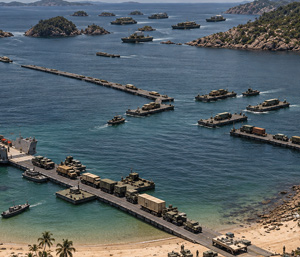
The proposed ferry builds on the Army and Navy’s modular causeway concept, with floating sections that connect like Lego block, a modern day “Mulberry Harbor” that some might remember from the D-Day landings. Configurable for different missions and compatible with U.S. and allied landing craft and vessels, the sections would have integrated propulsion for independent movement.
-
We want to provide a reasonable solution now, instead of being one of the classic DoD vendors proposing a solution that's decades away from reality.
The system would enable multiple coastal unloading points instead of relying on a single location vulnerable to attack or severe weather. Stark targets sea state five or higher and is exploring a future sink-and-refloat capability for concealment from aerial threats.
Equipment failures in locations without contractor support have shaped Stark’s approach to maintainability. Following the Army’s RAM principles of reliability, adaptability and maintainability, the equipment is designed for service members to troubleshoot and repair with minimal outside assistance.
Improving Reliability Through Field-Tested Engineering
This focus on reliability extends to existing Army causeways. Following the 2024 Gaza humanitarian mission, locking pins and connectors had failed even in sea states two and three. After investigating the problem for over a year, the Army Research Laboratory sought Stark’s watercraft expertise.
 Within 60 days, Stark analysed failed locking-pin samples, identified the root cause, redesigned components and recommended manufacturing improvements. The redesigned components are expected to improve reliability and safety while reducing costs when fielded by the Army.
The autonomous ferry is also advancing through military testing. At the Army’s 2025 XTech Pacific competition in Pearl Harbor, Hawaii, Stark tested a sensor-mule prototype and gathered feedback to guide further development.
Military feedback guides testing and refinement. Discussions with Army DevCOM and U.S. Indo-Pacific Command clarify Pacific operational requirements, while industry partners contribute autonomy software, propulsion and sensor expertise. Stark is also exploring an improved ribbon bridge system for the U.S. Army Corps of Engineers for riverine applications.
The same emphasis on practical, rapidly deployable equipment informs SkyCatcher. Developed in April 2026, the modular netting system is designed to protect assets and corridors from drones and be deployed by two service members within minutes. Stark reports Air Force and National Guard contracts and actively manufacturing Counter -UAS systems.
Plans include raising funding and testing a full-size, powered ferry prototype by summer 2027, followed by military user trials. The goal is an assembled system up to 800 feet long for Pacific deployment by summer 2028, with broader DoD availability a longer-term objective.
The system could also support military and humanitarian operations where ports are damaged or unavailable. Existing causeways have been used in such missions, including relief efforts following Haiti’s 2010 earthquake and the 2024 Gaza humanitarian operation, serving as a true maritime connector to overcome the last mile to the beach.
Stark Defense Industries’ operator-informed approach to improving ship-to-shore logistics has earned it recognition as the Top Modular Maritime Defense Solutions 2026.
Modular Maritime Defense Procurement Beyond Port Access
Moving military cargo by sea is only part of the logistics challenge. The next hurdle is getting it ashore when ports are damaged or unavailable. Even a fleet with sufficient transport capacity can struggle without reliable ways to unload equipment and supplies. Temporary causeway systems help bridge this gap, but conventional designs often depend on separate vessels for propulsion, large crews and relatively calm waters. These limitations become more serious when military forces need to establish several landing points quickly.
Sea conditions can determine whether a causeway system remains usable during an operation. Equipment designed for calm waters may have to stop working when waves become too rough. There is also a difference between surviving rough seas and continuing to transfer cargo safely. The strength of connections between modules, propulsion capability and the way assembled sections respond to waves all affect performance. Testing under realistic conditions is therefore important, rather than relying solely on stated sea-state ratings.
Crew requirements can place further pressure on military operations. Traditional modular causeways often need trained personnel to move and assemble sections, adding to the workload of units with limited watercraft crews. Autonomous navigation and assisted assembly could reduce this demand. However, automation must not make the equipment harder to maintain or operate when something goes wrong. Crews need a way to take control during faults, and essential functions should remain accessible without specialist intervention. Otherwise, reducing crew numbers could create a new dependence on technical support.
“Stark Defense Industries is developing a modular causeway ferry system that combines independent propulsion with autonomous movement, with the aim of reducing the need for separate support vessels and specialized crews.”
The ability to establish several landing points is another consideration. Relying on a single temporary pier leaves cargo operations vulnerable to disruption from drone threats, bad weather or damage to the landing site. Modular systems that can be deployed at different locations give commanders more options for moving supplies ashore. Their usefulness also depends on how well they connect with existing military equipment. Module connections, compatibility with landing craft and the ease of transporting sections between locations all influence deployment.
Manufacturing readiness matters as much as design ambition. A system may promise significant improvements but take years to enter service if it depends on unfamiliar manufacturing methods or an entirely new supply chain. Using established propulsion technologies and commercially available components can help shorten development, although these still need to be tested for maritime use. Procurement teams must consider how far a prototype has progressed, whether the design can be manufactured reliably and how easily replacement parts can be obtained.
Maintenance becomes especially important during extended operations away from established support facilities. Equipment that breaks down at a remote landing site cannot always wait for a contractor to arrive. Components should be accessible, faults relatively straightforward to identify and repairs manageable by military technicians. Replacement parts and technical documentation must also remain available without leaving operators entirely dependent on the original manufacturer.
Stark Defense Industries is developing a modular causeway ferry system that combines independent propulsion with autonomous movement, with the aim of reducing the need for separate support vessels and specialized crews. The company draws on existing maritime equipment and commercially available technologies while incorporating feedback from military end users.
Its work includes refining legacy causeway hardware and collaborating with defense industry partners on autonomy systems. The development program also targets improved performance in higher sea states and modular configurations that can support cargo transfers at dispersed shore locations.
These capabilities remain part of the company's development plans, with a full-size propelled prototype still to be completed. The distinction matters for defense buyers assessing what has been demonstrated and what remains to be tested.
For defense organizations seeking better ways to move cargo from ships to shore, Stark Defense Industries is pursuing a system designed around operational flexibility, compatibility with existing military watercraft and repairs that can be carried out in the field. Its approach addresses the practical demands of maritime logistics when access to established ports cannot be assured.
...Read more
| Share this Article: |
Company
Stark Defense Industries
Management
Jared McCully, Co-Founder
Description
Stark Defense Industries develops modular maritime defense solutions for military and commercial applications. Combining operational experience with practical engineering and established technologies, it is advancing autonomous causeway systems, improving equipment reliability and developing rapidly deployable drone protection.
