

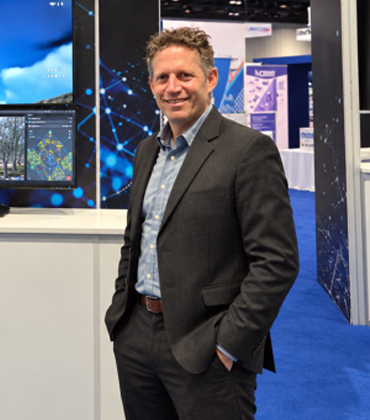
 Yuval Peshin, CEO
“Today, in many of the programs we support, simulation can replace approximately 75–80%, with select ones even 100% of simulated flight-training sorties while improving safety and mission capabilities,” says Yuval Peshin, CEO.
That shift reflects growing confidence in simulation alongside Simlat’s evolution. Early on, replacing 10–15 percent of live training was considered a strong result. Today, some customer relationships exceed 15 years, with Simlat adapting its systems as platforms, missions and training requirements change.
A Common Core for Different Missions
Simlat develops its products around a continuously evolving simulation engine, then adapts the surrounding configuration to different users and training goals. Customers can configure fidelity, integration, hardware, instructor functionality, visual environment and training complexity according to their requirements and budget. A compact station can support basic familiarization, while larger configurations can add multiple trainees, distributed participation, instructor control and system integration.
Customers can also use more than one Simlat product within the same training ecosystem. This creates a structured path for beginner operators, experienced crews, instructors and advanced mission specialists, with different levels of simulation complexity serving each stage.
-
Today, in many of the programs we support, simulation can replace approximately 75–80%, with select ones even 100% of simulated flight-training sorties while improving safety and mission capabilities.
The training environment extends beyond aircraft movement. It can model payloads, terrain, communications, failures, weather, mission events and instructor-generated challenges. COSMOS adds detailed visual datasets based on real areas, while ASTRA (Counter UAS/Drones Simulation) supports advanced scenarios and interactions between multiple simulated elements.
Simlat’s civil-UAS involvement dates back more than a decade. In 2012, it delivered a simulation system to Parks Air College, part of Saint Louis University, for UAS flight-safety research and training. It later supplied training systems to the Federal Aviation Authority (FAA), universities and aerospace institutes involved in UAS research, training and operations.
The modular architecture allows civil and commercial users to begin with preconfigured or tailor-made scenarios for inspection, agriculture, emergency response, mapping or search and rescue. Defense customers often need more independence. Simlat’s instructor tools let them create and modify scenarios, control threats and failures and adjust environmental or mission variables without returning to the supplier for every change.
Building Repeatable Training Standards
Simulation gives organizations a way to evaluate trainees under consistent conditions. Simlat’s instructor, monitoring, recording and debriefing capabilities support assessment of technical performance and mission decision-making. MAARS and PANEL add performance evaluation and instructor insight, while controlled scenarios allow the same weather, failure or emergency conditions to be repeated across trainees.
That repeatability can support defined learning objectives, qualification standards and recurrent training. It also reduces dependence on aircraft availability, airspace, weather and maintenance. For customers managing several platforms and payloads, the same flexible environment can serve as common training infrastructure across mission types.
This depth comes from accumulated use as much as product development. Simlat has supported more than 150 UAS and drone programs across over 30 countries, with more than one million hours of simulated training activity.
Training the Human-Machine Team
The next stage is increasingly shaped by autonomy. Operators are moving from controlling one aircraft toward supervising autonomous behavior, managing multiple vehicles and intervening when human judgment is required. Simlat is helping prepare operators for that shift through heterogeneous fleets, distributed training and counter-UAS scenarios. Simlat sees simulation moving across the full unmanned-system lifecycle, from engineering and integration to mission rehearsal, recurrent training and readiness.
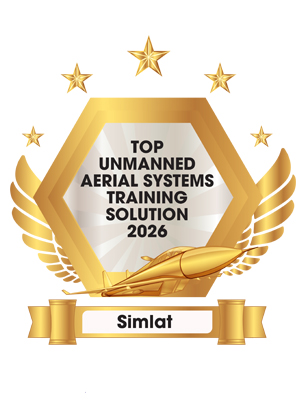
Its recognition as the Top Unmanned Aerial Systems Training Solution 2026 reflects a training approach shaped by more than two decades of specialization, long-term customer continuity, military grade quality, and continued adaptation to changing mission demands.
UAS Training Systems beyond Basic Flight Simulation
Unmanned aerial systems training becomes difficult to standardize when crews operate aircraft from different manufacturers under changing mission requirements. Live-flight exercises remain necessary, but aircraft availability, restricted airspace and unpredictable weather limit how consistently instructors can reproduce demanding conditions. Simulation offers greater control, although purchasing a system that reproduces flight behavior without supporting complete mission exercises can leave significant training gaps.
The distinction begins with simulation fidelity. Accurate aircraft handling alone provides limited preparation for missions involving sensor interpretation, communication interruptions or unexpected changes in terrain conditions. Training environments must reproduce the interaction between aircraft behavior and mission equipment while allowing instructors to introduce realistic complications. Fidelity should reflect the actual aircraft configurations and tasks personnel encounter rather than visual sophistication alone.
A platform's integration architecture determines how readily training can accommodate changes in fleet composition. Defense organizations frequently operate multiple aircraft classes and payload configurations, sometimes procured from separate manufacturers. Maintaining isolated simulators for each platform can increase instructor workload and complicate common training standards. Systems that accommodate different control interfaces and mission configurations within a shared environment offer greater flexibility. Procurement teams should establish how much integration requires supplier engineering and whether new aircraft configurations can be introduced without replacing existing infrastructure.
Instructor independence also affects the usefulness of simulation after deployment. Fixed scenario libraries can support introductory training, but mission requirements rarely remain static. Changing threat conditions or newly identified failure modes may demand exercises that were not anticipated during procurement. Instructors need sufficient control over environmental variables and mission events to develop relevant scenarios internally. Restricted authoring tools can create recurring supplier dependencies, particularly where training content must change quickly.
“Simlat combines configurable simulation environments with instructor controls that support scenario development, performance monitoring and structured debriefing across different training requirements.”
Assessment presents a different difficulty. Live exercises rarely expose every trainee to identical conditions, making direct performance comparisons unreliable. Simulation can establish repeatable exercises, but the assessment process must capture more than successful mission completion. Decision timing, response to equipment failures and crew coordination provide a fuller picture of readiness. Recording and debriefing functions should allow instructors to examine the sequence of decisions rather than rely primarily on subjective observations.
Training capacity introduces further tradeoffs. A compact station may serve individual familiarization, while larger academies require simultaneous instruction and coordinated mission exercises. Distributed participation can become necessary when crews and instructors occupy different locations. Buyers should establish whether expansion involves additional licenses, dedicated hardware or substantial changes to the original installation.
Increasing aircraft autonomy complicates this investment horizon. Personnel may spend less time directly controlling aircraft and more time supervising automated behavior or intervening during exceptions. Simulation procurement must account for these changing responsibilities without assuming that every emerging technology requires an entirely new training system.
Simlat develops modular UAS simulation environments for different aircraft configurations and training arrangements, from individual stations to larger training centers. Its architecture allows customers to configure simulation fidelity and system integration around specific mission requirements. Instructors can modify mission events and environmental conditions independently, while its MAARS and PANEL solutions provide assessment capabilities. FORNAX supports detailed visual datasets and ASTRA enables advanced mission simulation. Defense organizations and training academies managing mixed fleets, recurrent qualification requirements or changing mission scenarios can use this approach to maintain common training infrastructure while retaining control over exercise development.
...Read more
| Share this Article: |
Company
Simlat
Management
Yuval Peshin, CEO
Description
Simlat develops UAS simulation and training environments built on more than two decades of specialization and experience across 150-plus programs. Its modular architecture supports mission rehearsal, instructor-led training, autonomous systems and multi-platform operations, helping defense and commercial organizations standardize training and prepare for missions.
